Introducing ARIA: AI for Regulatory Intelligence & Authoring, our new AI agent, built on everything you already know from NuMantra.

October 8, 2026
admin
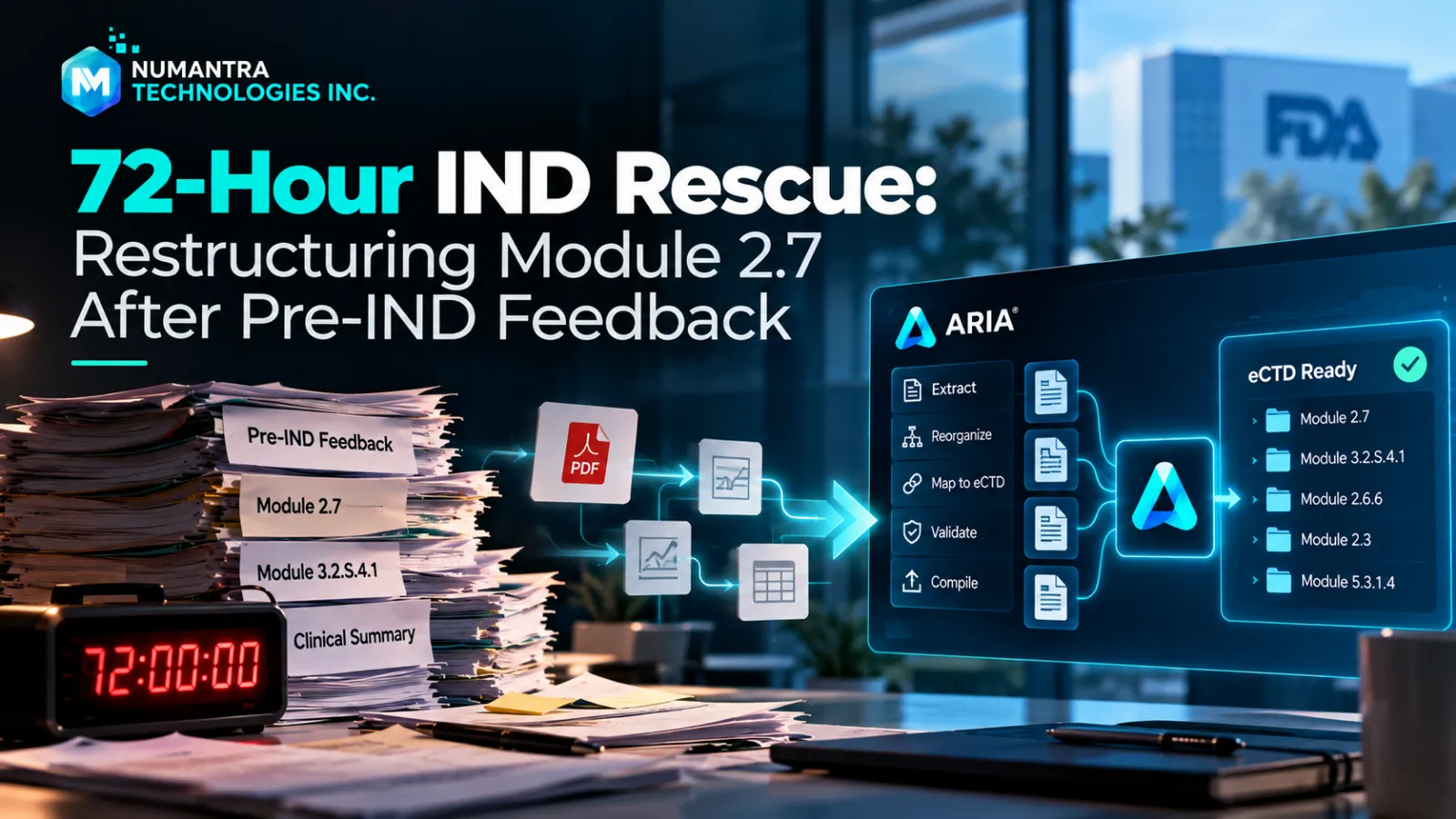
72-Hour IND Rescue: Restructuring Module 2.7 After Pre-IND Feedback
The Pre-IND Feedback Trap That Costs $2M Per Quarter
You exit the FDA Pre-IND meeting with 14 pages of meeting minutes. Buried in Section 4, Clinical Development Plan, the Agency requests “substantial reorganization of the Module 2.7.3 Clinical Summary to separately address single-dose and repeat-dose toxicology findings, with cross-references to updated Module 3.2.S.4.1 stability data reflecting the proposed commercial container closure system.”
Your IND submission window closes in 72 hours. Miss it, and your Phase 1 trial start date slips six months. At a $350K monthly burn rate for a 12-person team, that delay costs $2.1M in operational runway before a single patient enrolls.
This is not a hypothetical scenario. For emerging biotech sponsors, the gap between Pre-IND guidance and submission-ready eCTD restructuring represents the highest-stakes regulatory bottleneck in early development. The technical challenge is not writing new science, it is surgically reorganizing existing CMC data, nonclinical narratives, and clinical summaries into the exact CTD structure FDA expects, while maintaining every hyperlink, every table reference, and every ICH M4 formatting requirement across 400+ interconnected files.
Traditional document management systems were built for linear authoring and version control, not emergency cross-module restructuring under time pressure. This article walks through the exact 72-hour workflow for Module 2.7 and Module 3.2.S.4.1 reorganization, using AI-native regulatory intelligence to preserve submission integrity while meeting impossible deadlines.
Hour 0-12: Triage and Structural Gap Analysis
- Parsing FDA Meeting Minutes Into Actionable CTD Edits
The first 12 hours determine whether you meet the deadline or request a submission extension. FDA Pre-IND feedback arrives as unstructured meeting minutes, not as a marked-up eCTD table of contents. Your immediate task is translating narrative guidance (“separately address single-dose and repeat-dose toxicology”) into specific CTD section splits and file relocations.
ARIA, NuMantra’s AI Regulatory Intelligence and Authoring platform, parses FDA meeting minutes and maps requested changes to specific ICH M4Q(R1) section codes. The Classify hub identifies every existing file that requires modification based on semantic similarity between FDA language and current document content, surfacing a prioritized edit list with confidence scores per assignment.
For a mid-size oncology biotech preparing an IND amendment after Pre-IND feedback, ARIA’s layout-aware OCR engine ingested 340 existing PDF files (nonclinical study reports, stability data tables, clinical protocols) and flagged 23 documents requiring structural changes, 67 documents requiring updated cross-references, and 8 documents requiring complete regeneration. Total triage time: 90 minutes, compared to 8-12 hours for manual CTD gap
analysis.
- Isolating Module 3.2.S.4.1 Stability Data Dependencies
Module 3.2.S.4.1 (Stability Summary and Conclusions) is the most hyperlink-dense section in any IND. A single stability table update cascades into Module 2.3.S (Drug Substance Summary), Module 2.7.4 (Clinical Summary of Safety), and Module 5.3.1.4 (Clinical Protocol inclusion/exclusion criteria referencing shelf life).
Before rewriting a single sentence, map every inbound and outbound hyperlink for the affected stability section. ARIA’s Validate hub performs automated dependency mapping, generating a visual graph of every file that references Module 3.2.S.4.1 data. This prevents the most common emergency IND failure mode: updated CMC data in Module 3 with orphaned hyperlinks in Module 2 clinical summaries, triggering FDA validation errors on submission.
Hour 12-36: Automated Module 2.7 Narrative Regeneration
- Restructuring Clinical Summaries Without Rewriting Science
Module 2.7.3 (Summary of Clinical Pharmacology Studies) and 2.7.4 (Summary of Clinical Safety) are narrative syntheses of underlying nonclinical and clinical data. FDA Pre-IND feedback requiring “separate discussion of single-dose versus repeat-dose findings” does not demand new toxicology studies, it demands reorganized narrative structure with updated subheadings and cross-references.
The bottleneck is not scientific judgment (your toxicologist already knows the NOAEL values), it is the mechanical task of splitting 40 pages of integrated toxicology narrative into two parallel sections, each with its own table of contents, each with updated hyperlinks to the correct Module 4.2.3 study reports.
ARIA’s Author hub generates Module 2.7 narrative sections from structured source data (toxicology study reports, PK/PD tables, exposure margin calculations) aligned to an approved language library. For emergency restructuring, the workflow is:
- Extract existing Module 2.7.3 content into structured data fields (study ID, dose level, exposure duration, NOAEL, adverse findings).
- Define new section templates (2.6.6.3.1 for single-dose, 2.6.6.3.2 for repeat-dose) with ICH M4Q(R1)-compliant subheadings.
- Auto-populate templates with filtered data (single-dose studies route to 2.6.6.3.1, repeat-dose studies route to 2.6.6.3.2).
- Regenerate cross-references to updated Module 4.2.3 study report file paths.
- Human review and approval of generated narrative before compile
Every generated sentence links back to the exact source table or study report paragraph it summarizes. Regulatory reviewers can audit the narrative generation logic in real time, ensuring scientific accuracy while meeting the 72-hour deadline.
Parallel Module 3.2.S.4.1 Stability Table Regeneration
While Module 2.7 narratives regenerate, Module 3.2.S.4.1 stability data requires simultaneous updating. FDA requested “stability data reflecting the proposed commercial container closure system,” which means replacing existing HDPE bottle data with new borosilicate vial data across 12 time points and 3 storage conditions.
ARIA’s Author hub ingests raw LIMS exports (CSV or Excel format) and generates ICH Q1E-compliant stability tables with:
- Correct ICH Q1A(R2) storage condition formatting (25°C ± 2°C / 60% RH ± 5% RH)
- Automated out-of-specification flagging for any data point exceeding predefined acceptance
criteria. - Cross-linked analytical method references to Module 3.2.S.4.2 (validation reports).
The generated Module 3.2.S.4.1 narrative includes a summary conclusion paragraph (“Stability data support a 24-month shelf life when stored at 2-8°C in borosilicate vials”) with direct hyperlinks to the underlying data tables. Total generation time for 12-month stability summary with 36 data points: 15 minutes, compared to 6-8 hours for manual table formatting and narrative drafting.
Hour 36-60: eCTD Validation and Cross-Module Hyperlink Reconciliation
- The Hidden Killer: Orphaned Hyperlinks After Structural Changes
You have regenerated Module 2.7.3, updated Module 3.2.S.4.1, and restructured Module 2.6.6 into parallel subsections. The content is scientifically accurate. But if a single hyperlink in Module 2.7.4 still points to the old, pre-restructure Module 2.6.6.3 file path, FDA’s ESG validation will reject the entire submission with a “broken hyperlink” error.
eCTD 3.2.2 and eCTD 4.0 XML validation requires that every “ element in the backbone XML references an existing file in the submission package, and every internal hyperlink resolves to a valid destination within the same submission. Manual hyperlink reconciliation after emergency restructuring is the leading cause of last-minute IND submission failures.
ARIA’s Validate hub performs three-layer validation before compile:
- XML schema validation against FDA eCTD 3.2.2 DTD and EMA eCTD 4.0 specifications.
- Hyperlink integrity checking for every internal cross-reference, flagging orphaned links with the exact source file and line number.
- Final eCTD backbone review in a staging environment before submission.
For the oncology biotech IND amendment scenario, ARIA flagged 14 orphaned hyperlinks in Module 2.7.4 that still referenced the old Module 2.6.6.3 file path (before the single-dose/repeat-dose split). Each flagged link included the source paragraph and the correct destination file path for manual correction. Total validation time: 20 minutes. Manual hyperlink auditing for a 400-file eCTD package: 12-16 hours.
- Automated Multi-Regional Backbone Assembly
If your IND includes a parallel CTA submission to Health Canada or a future MAA to EMA, the same clinical and CMC content must compile into region-specific eCTD backbones with different granularity requirements. FDA eCTD allows combined Module 2.7 summaries; EMA requires separate Module 2.7.2, 2.7.3, and 2.7.4 files.
ARIA’s Publish hub auto-generates region-specific eCTD backbones from a single source content repository. The same Module 2.7.3 narrative compiles into FDA eCTD 3.2.2 format (single integrated summary) and EMA eCTD 4.0 format (separate pharmacology and safety files) without manual file duplication. This eliminates the risk of divergent content across regional submissions, a common FDA/EMA inspection finding.
Hour 60-72: Final Human Review and Submission Package Assembly
- The Non-Negotiable Human Review Gate
ARIA augments regulatory professionals, it does not replace review. Every generated Module 2.7 narrative, every updated Module 3.2.S.4.1 table, and every validated hyperlink requires human sign-off before final compile.
The 72-hour workflow allocates 12 hours (Hour 60-72) for:
- Senior regulatory reviewer approval of all AI-generated narratives.
- QA cross-check of stability data against original LIMS exports.
- Metadata completeness verification (document dates, version numbers, author attribution per 21 CFR Part 11 requirements).
ARIA’s Knowledge Backbone connects every generated sentence to its source data, enabling reviewers to audit the narrative generation logic in real time. If a Module 2.7.3 exposure margin calculation appears incorrect, the reviewer clicks the linked source table, verifies the underlying PK data, and approves or rejects the generated text. Total review time for 23 regenerated documents: 8 hours, compared to 40+ hours for traditional document-by-document review.
- Emergency IND Submission Checklist
Before final submission to FDA ESG, verify:
- All FDA Pre-IND meeting minute action items addressed in updated CTD sections.
- Module 2.7.3 and 2.7.4 narratives reflect restructured Module 2.6.6 subsections.
- Module 3.2.S.4.1 stability data matches proposed commercial container closure system.
- Every internal hyperlink validated (zero orphaned links).
- eCTD XML backbone passes FDA ESG validation in test environment.
- All document metadata (dates, versions, authors) compliant with 21 CFR Part 11.
- Regional backbone variants (FDA, Health Canada, EMA) compiled from single source.
The $2M Question: Can You Afford Not to Automate?
A missed IND submission window costs emerging biotech sponsors six months of clinical trial delays and $2M+ in extended operational burn. The 72-hour emergency restructuring workflow described here is not theoretical, it is the operational reality for every sponsor receiving substantive FDA Pre-IND feedback within days of a submission deadline.
Traditional regulatory document management systems were built for linear authoring and version control, not for emergency cross-module restructuring with real-time hyperlink reconciliation. AI-native regulatory intelligence platforms like ARIA are purpose-built for this exact bottleneck: surgical reorganization of existing eCTD content under time pressure, with automated validation and multi-regional backbone assembly.
The oncology biotech case described here (340 files, 23 documents requiring regeneration, 67 requiring updated cross-references) completed the full 72-hour workflow with 18 hours to spare. Total human effort: 32 hours (triage, review, QA). Equivalent manual effort for the same scope:
120+ hours, requiring a submission extension and six-month trial delay.
If you are preparing an IND submission within the next 90 days, or managing multiple sponsor clients in active Pre-IND cycles, you cannot afford to discover your emergency restructuring workflow gaps during a live 72-hour deadline.
Schedule a 15-minute ARIA demo to see automated Module 2.7 narrative generation, real-time eCTD hyperlink validation, and multi-regional backbone assembly in action. Walk through a live emergency IND restructuring scenario with your own CMC data and clinical summaries, and see exactly how AI-native regulatory intelligence eliminates the $2M submission delay risk.
Book your live ARIA demo now. See emergency Module 2.7 restructuring, automated stability table generation, and real-time eCTD validation in a 15-minute walkthrough tailored to your current IND timeline.