Introducing ARIA: AI for Regulatory Intelligence & Authoring, our new AI agent, built on everything you already know from NuMantra.
October 1, 2026
admin
eCTD 4.0 Lifecycle Management and Tagging: A Practical Guide
For regulatory operations teams managing pharmaceutical and biotech submissions, the transition from eCTD v3.2.2 to eCTD 4.0 changes more than the technical format. It changes lifecycle management at every level, altering how documents get tagged, how sequences relate to one another, how operations get applied to existing submission content, and how the submission history is structured for FDA review and inspection. If your team is bracing for this shift, you’re not alone. Teams that approach eCTD 4.0 as a publishing upgrade tend to find the transition harder than expected. The format is really a shift in submission architecture, and lifecycle management and tagging are where that shift is most operationally significant.
This eCTD 4.0 lifecycle management tagging guide is aimed at regulatory operations managers, publication teams, and high-level regulatory affairs executives responsible for preparing a submission. It covers what the lifecycle model means in the context of eCTD 4.0, how tagging in eCTD 4.0 differs from the process in eCTD 3.2.2, typical implementation mistakes, and the controls you’ll want in place before your first sequence goes out. It also looks at how connected regulatory knowledge, which NuMantra is building into its ARIA platform, can support those controls as your submission history grows.
Why eCTD 4.0 Changes How Lifecycle Management Works
In eCTD v3.2.2, publishing teams handle lifecycle management at the leaf level using a combination of file replacement, deletion, and append operations. Most teams recognize this structure well, but it comes with known limitations. It leaves the relationship between documents across sequences implicit rather than explicit, and reconstructing the lifecycle history means reading the sequence index in the correct order.
In eCTD 4.0, this is replaced by the context-of-use model. Here, documents are associated not with a specific file but with their context of use, and lifecycle operations are applied to that context rather than directly to the file. The key difference is that a document’s context is separated from its identity as a file. A single file can have multiple contexts, and a context of use can be modified, deactivated, or removed without touching the file itself.
The upshot is that lifecycle management in eCTD 4.0 asks for a lot more forethought. The implicit assumptions about ordering that worked fine in v3.2.2 won’t hold here. Each operation has to be applied deliberately to the correct context, and properly tagged and ordered within the submission. Mistakes that would have surfaced (and been fixed) later in v3.2.2 carry more serious implications in eCTD 4.0.
What could go wrong: Teams that apply v3.2.2 lifecycle logic to eCTD 4.0 submissions, treating it as a file-replacement exercise rather than a context-management exercise, end up with submissions that have incorrect lifecycle relationships. FDA validation catches some of these errors, but not all of them. Structurally correct-on-paper lifecycle operations that pass technical validation can still create review confusion and require corrective sequences down the line.
How Document Tagging Works in eCTD 4.0
Tagging in eCTD 4.0 is more granular and more explicit than in v3.2.2. The format uses a structured XML backbone, based on the Health Level Seven (HL7) Regulated Product Submission (RPS) standard, that requires each document and each context of use to carry defined metadata.
Context of Use and Document References
In eCTD 4.0, the submission index separates document references from contexts of use. A document reference identifies the file itself, with its title, format, language, and unique identifier. A context of use places that document within the submission hierarchy and defines its function at that location.
This split means tagging is a two-layer responsibility. Your publishing team needs to get the file-level tagging right (title, document type, format, language, and checksum) and the context-level tagging right (section code, operation type, display name, and the relationship to preceding documents). An error at either layer will affect the lifecycle process.
Operation Types and When to Use Them
eCTD 4.0 uses defined operation types to describe what each context of use is doing in the current sequence. Knowing when each one applies is central to getting lifecycle management right.
The primary operation types are:
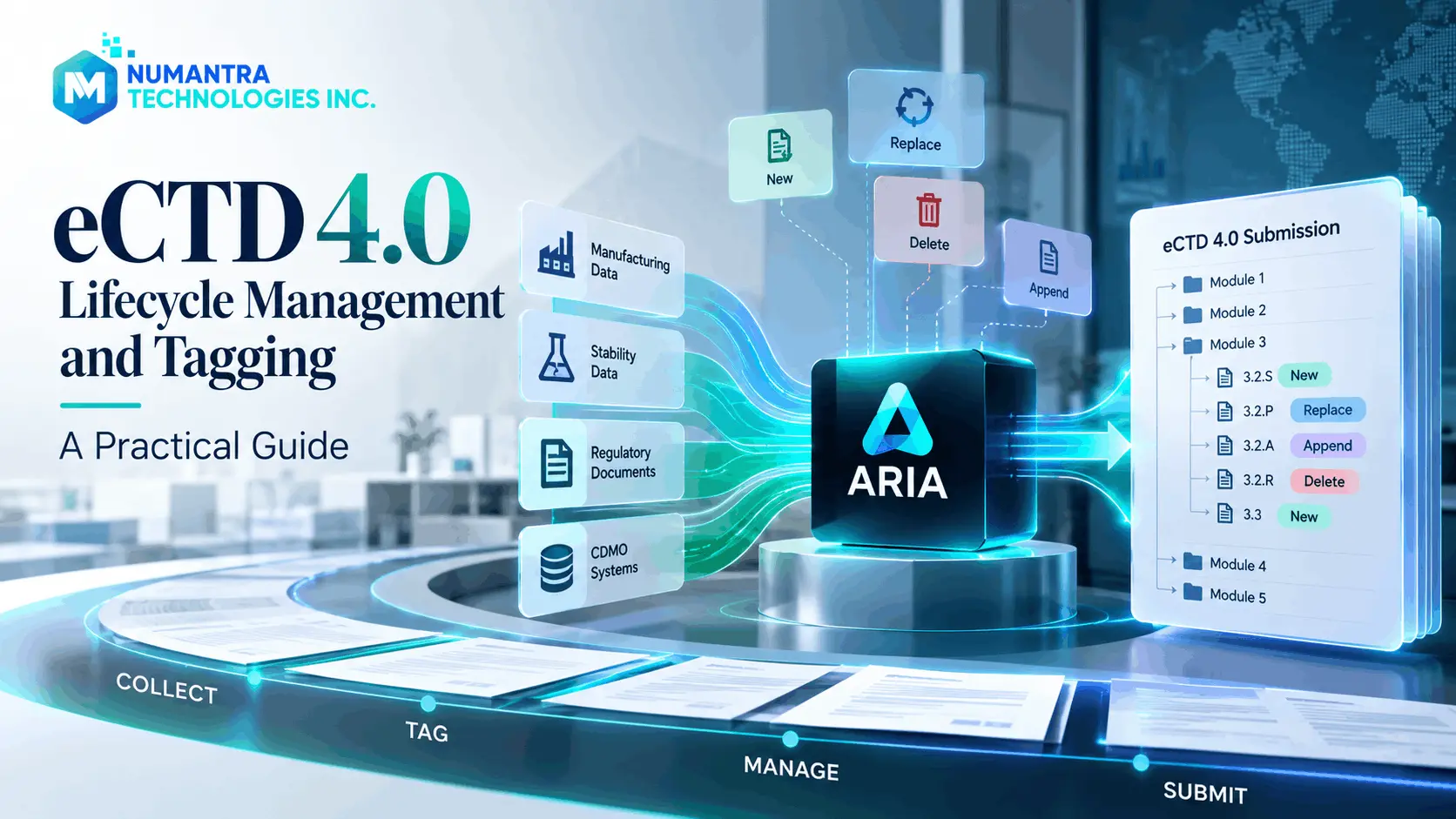
- New: Used when a context of use is being introduced in the submission for the first time. This applies to entirely new sections or new document placements with no prior lifecycle history in that context.
- Replace: Used when an existing context of use is being updated with new content. The replace operation points back to the prior context, creating an explicit link in the lifecycle chain. It’s the most commonly used operation in amendment and supplement sequences.
- Delete: Used when a context of use is being permanently removed from the submission. A deleted context is no longer part of the active submission view. Apply this one carefully, since deleting a context that’s still referenced elsewhere in the submission creates an integrity error.
- Append: Used in specific scenarios where content is added to an existing context without replacing it. This is less common than Replace and applies in situations defined by FDA technical conformance guidance.
What could go wrong: Using New instead of Replace when updating existing content is one of the most common tagging errors in eCTD 4.0, and it’s worth watching for specifically. It breaks the lifecycle chain, where the prior version and the new version show up as disconnected contexts rather than a documented progression. FDA reviewers may not immediately be able to tell which version is current, and the submission history becomes unreliable.
Display Name Requirements
Each context of use in eCTD 4.0 carries a display name, sometimes referred to as the leaf title, the human-readable label that identifies the content to the reviewer. Display names need to be specific, consistent with the document content, and aligned with your submission’s naming conventions.
Generic display names like “Clinical Study Report,” “Module 3 Document,” or “Updated Protocol” create real navigational headaches for reviewers. A good display name should make clear what the document is, what it contains, and its version or date.
How Sequences Work in eCTD 4.0 and Where Teams Get Them Wrong
Each eCTD 4.0 submission is organized into sequences. The initial sequence establishes the baseline submission. Every sequence after that, including amendment, supplement, response, and annual report, adds to, modifies, or removes content from the active submission view.
In eCTD 4.0, the relationship between sequences is governed entirely by the lifecycle operations assigned to each context of use. The active submission view at any point is the cumulative result of all prior sequences read in order. That means an error in an early sequence, such as a missed Replace operation, or an incorrectly deleted context, propagates forward through every subsequent sequence until someone catches and corrects it.
Planning the Sequence Before Publishing
eCTD 4.0 sequences call for more advance planning than v3.2.2 sequences did. Before building a sequence, your publishing team needs to know:
- Which contexts of use from prior sequences are being updated
- Which prior contexts each Replace operation points to
- Whether any contexts are being deleted, and whether those deletions affect dependent content
- Whether any new contexts are being introduced, and whether they require new section codes
- How the active submission view will look once the sequence is applied
This planning step isn’t optional. Teams that start building a sequence without a confirmed lifecycle plan will end up revising mid-publication, which is a time-consuming process that also introduces the risk of inconsistency between the authored content and the submission structure.
Managing Responses to Review Questions
The response sequence in eCTD 4.0 deserves special attention. Responses to information requests or complete response letters can trigger revisions across more than one module, and each revised context needs the appropriate Replace operation pointing to the version it supersedes.
Teams should also double-check that response sequences don’t inadvertently touch contexts that weren’t part of the response. In v3.2.2, this kind of scope creep was manageable because the file-replacement model was simpler. In eCTD 4.0, an incorrectly scoped operation can shift the lifecycle view of sections the team never intended to change.
Getting the scope right depends on knowing exactly what was submitted before, and where. When a single information request touches content from several earlier sequences, the team has to locate each prior context, confirm its current version, and cite it correctly in the response. A searchable record of past submissions shortens that step considerably, and it is one of the problems ARIA’s Knowledge Backbone is being built to address.
What could go wrong: An automated response strategy that applies Replace commands more broadly than intended can update parts of the active submission view outside the scope of the actual response. When that happens, reviewers may find updates on sections they never questioned, which tends to generate more questions and delay than it saves.
What FDA Validation Catches and What It Doesn’t
The technical requirements for eCTD 4.0 submission conformity are laid out in the FDA’s conformance guidance and validation rules. Validation covers structure-based criteria, such as schema validation, metadata completeness, file format requirements, checksum verification, and lifecycle requirements.
That technical validation is essential, but it isn’t sufficient on its own. It confirms the structure is valid, but doesn’t confirm the lifecycle operations were carried out correctly, that the active submission view matches the intended version, or that display names match the document titles.
This distinction matters because most lifecycle-operation errors don’t actually violate validation rules. A submission can meet every FDA validation requirement and still carry lifecycle issues that confuse reviewers, misstate the submission history, or misrepresent what’s actually current.
In other words, before every submission sequence goes out, someone with regulatory operations expertise needs to review the active submission view and confirm that the lifecycle operations used actually produce the intended content state and prior-version relationships, and that no context has been accidentally created, replaced, or deleted.
Tooling can support that review, though the reviewer still makes the call. ARIA’s Review Intelligence capability is designed to progressively surface missing information, inconsistencies, and low-confidence classifications across connected submission content, which gives the person signing off on the sequence a shorter list of items to check by hand.
Building the Controls That eCTD 4.0 Lifecycle Management Requires
eCTD 4.0 isn’t a format that tolerates informal publishing processes. The explicitness of the context-of-use architecture means lifecycle management needs documented controls, not just experienced publishers, but defined procedures, checkpoints, and review standards. Think of the rest of this eCTD 4.0 lifecycle management tagging guide as the operational playbook for building that rigor.
Establish a Lifecycle Plan for Every Sequence
Before any sequence goes to publication, your regulatory team should build a lifecycle plan documenting every prior context of use it relates back to, the operation type used, and the reason for the update. This informs the publishing process, while also creating a lifecycle record you can pull up later if questions come up.
The plan itself doesn’t need to be complicated. A table covering section codes, context information, operation types, references to prior contexts, document titles, and author sign-offs is usually enough to catch most problems before publication.
Define and Enforce Display Name Standards
Display name inconsistency is one of the most visible quality problems in eCTD 4.0 submissions, and, fortunately, one of the easiest to prevent. Before your first sequence is published, get your team aligned on display name conventions for each document type: what elements are required, in what order, at what level of specificity, and in what format.
Every contributor needs to follow these conventions. When new sequences go out, check display names against previously published sequences for consistency. Any unnecessary change to a display name across sequences creates confusion for the reviewer.
This is one place where historical submissions become directly useful. ARIA’s Knowledge Backbone is being designed to match new content against previously submitted sequences, so a display name or document title that drifts from an earlier convention can be flagged and corrected before publication.
Review the Active Submission View Before Each Sequence Submission
The active submission view is the cumulative picture of the submission as FDA reviewers will see it once the current sequence is applied. Reviewing it before submission, not just after validation, is the most reliable way to catch lifecycle errors before they reach the agency.
This review should confirm that:
- All required modifications appear in the active view.
- No unintended modifications have been applied.
- Removed contexts no longer appear in the active view.
- New contexts are positioned in the right places.
- The version shown next to each context is the intended latest version.
- Display names match the context contents and prior naming conventions.
This step calls for regulatory operations judgment, not just publishing tools. The reviewer needs to understand what the submission should look like, not just whether the technical structure passes.
Maintain a Sequence Registry
As sequences accumulate across a product’s lifecycle, tracking their history manually eventually becomes unmanageable. A sequence registry is a maintained record of every sequence submitted, along with its contexts, the operations performed, and the reasoning behind them.
The registry also earns its keep when planning future sequences. When an amendment or supplement needs to update content from a sequence submitted months or years earlier, the registry gives you the context identifiers and lifecycle history you need to build the new operations correctly.
What could go wrong: Teams without a registry tend to dig back through old submission packages to piece together lifecycle history when they need it, which is a slow, error-prone process. If a problem in a previous sequence’s lifecycle went unnoticed at the time, it can get missed entirely.
A registry is also only as useful as the context around it. Recording that a Replace operation happened in sequence 0012 helps. Knowing which source document, reviewer comment, or internal decision prompted it helps more, especially after the people who made that call have moved on to other products or left the company. ARIA’s Organizational Memory capability is designed to keep that history attached to the submission record, including source information, generated content, manual changes, and the decisions behind them.
Where ARIA Fits Into eCTD 4.0 Lifecycle Management
The controls described above are procedural, and they should stay that way. They also produce a growing body of information, such as lifecycle plans, sequence registries, prior submissions, reviewer questions, and the source documents behind each context of use. In most organizations, that information sits in separate files and systems, and someone has to find and interpret it manually every time a new sequence is planned.
NuMantra’s ARIA platform currently supports OCR-based document understanding, AI-supported authoring, and eCTD classification. NuMantra is now building a Knowledge Backbone underneath those capabilities that connects regulatory content, submission structure, source evidence, versions, and the relationships between them. For lifecycle management, it is designed to let teams:
- Search across previous submissions and cite the specific documents and contexts a new sequence relates to.
- Generate new documents using data from previous submissions or from external sources, with traceability back to the supporting evidence.
- Match new content against historical submissions, and correct titles, display names, or content that disagree with what was submitted before.
- Trace how a context of use has changed across sequences, and which requirements or source documents were involved.
The Knowledge Backbone combines two ways of finding information. A structured layer records how things are connected: which module a document belongs to, which prior context a Replace operation points to, and where a citation comes from. Semantic search sits alongside it and finds related content even when the wording differs, such as every reference to a particular stability study across a product’s submissions. The first handles lifecycle questions that depend on exact relationships. The second handles open-ended questions where the team doesn’t know in advance which documents are relevant.
Human review stays in the process. The Knowledge Backbone is meant to give regulatory operations teams faster access to the right information and clearer traceability back to source evidence, while the judgment calls described throughout this guide remain with them.
Conclusion
Lifecycle management and tagging in eCTD 4.0 aren’t problems software alone can solve. They’re an operational discipline that has to be planned and controlled, and the teams who build that control before their first eCTD 4.0 sequence goes out carry meaningfully less risk than those who treat eCTD 4.0 as a natural evolution of v3.2.2 habits.
For regulatory operations leaders, the real question isn’t whether eCTD 4.0 demands more rigor than v3.2.2; it does. The question is whether you build that rigor into your process now, or absorb the cost of lifecycle errors later, when they’re harder and more expensive to fix. This eCTD 4.0 lifecycle management tagging guide is meant to help you do the former.
NuMantra Technologies helps regulatory operations teams implement submission-ready eCTD 4.0 processes, and its ARIA platform is being developed to connect the submission knowledge those processes depend on. If you want to evaluate what your current lifecycle management practices are costing you operationally, our Cost Savings Calculator is a useful place to start. And to go deeper into the format requirements and lifecycle controls covered here, download the full eCTD 4.0 Guide.
References
- FDA — eCTD Submission Standards for eCTD v4.0 and Regional M1
- FDA — eCTD Technical Conformance Guide v4.0
- FDA — Electronic Common Technical Document (eCTD)
- FDA — Providing Regulatory Submissions in Electronic Format – Submissions Under Section 745A(a) of the FD&C Act
- HL7 — Regulated Product Submission (RPS) Standard
- ICH — M8: Electronic Common Technical Document (eCTD)