Introducing ARIA: AI for Regulatory Intelligence & Authoring, our new AI agent, built on everything you already know from NuMantra.

September 28, 2026
Creative buffer
First IND Submission with 3 People: A Module-by-Module Checklist
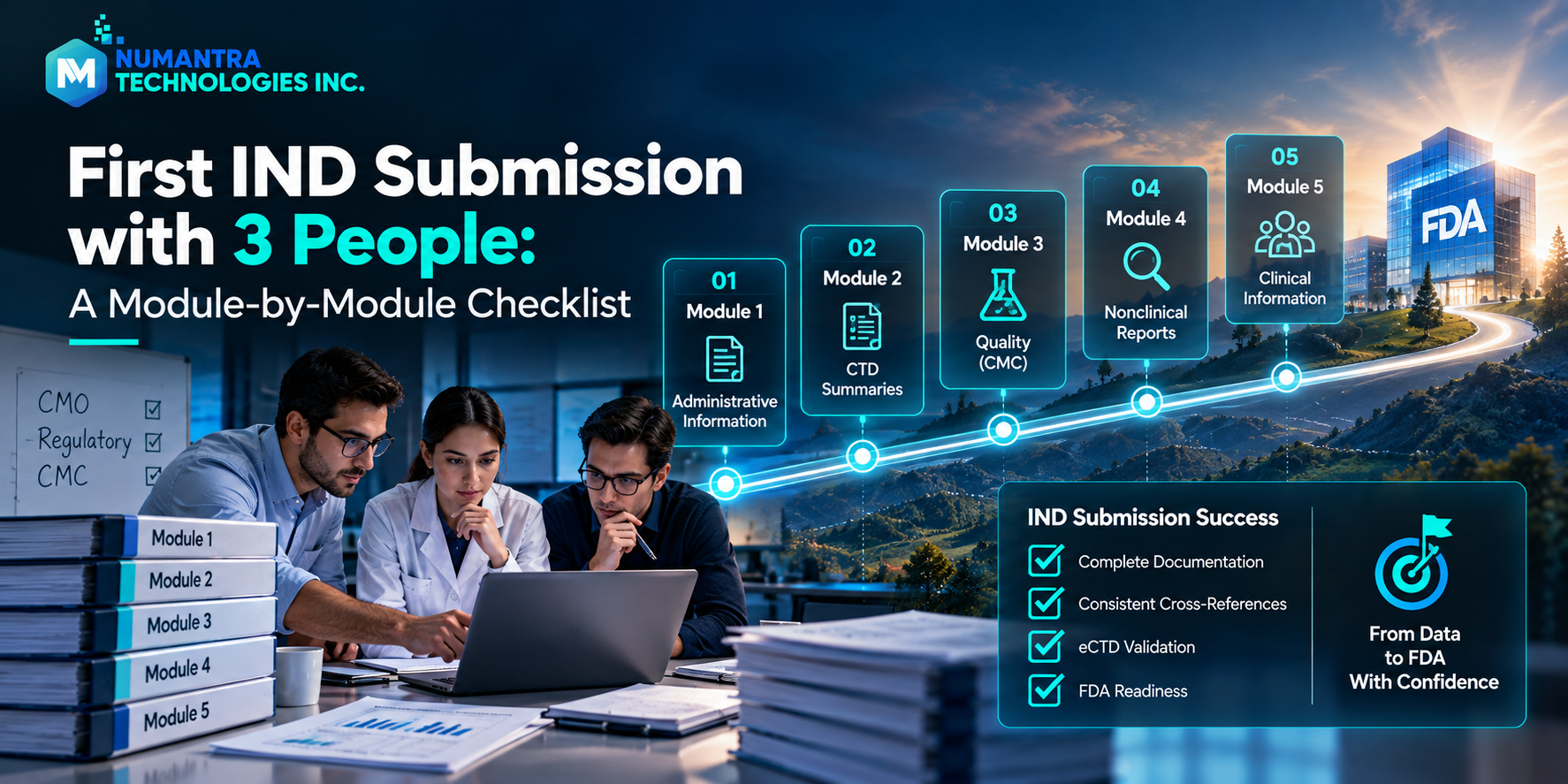
- – A first IND is defined by 21 CFR 312.23, then organized into CTD modules. Knowing the mapping saves weeks.
- – Write Module 2 last. The summaries depend on Modules 3, 4 and 5 being stable.
- – Most avoidable IND problems are consistency problems: product names, batch numbers, study identifiers and cross-references that do not match.
- – Small teams lose the most time on file sorting, cross-reference upkeep and hyperlink checks, not on science.
Consider a hypothetical emerging biotech with a promising Phase 1 candidate and three people to build the IND: a CMO with clinical trial experience, a head of regulatory affairs who reviewed submissions at a CRO but has not assembled one, and a CMC lead. Nobody on the team has authored a Module 2.6.7 tabulated summary. Every hour spent renaming files or chasing a broken hyperlink is an hour not spent on the starting-dose rationale.
The stakes are concrete. Under 21 CFR 312.40(b), an IND goes into effect 30 days after FDA receives it unless FDA imposes a clinical hold under 21 CFR 312.42. A hold is often triggered by gaps in safety, nonclinical or CMC information, and small teams are more exposed because the eCTD framework assumes familiarity with 21 CFR 312.23, ICH M4 organization and cross-module linking conventions.
This checklist walks through each module, shows where lean teams typically slip, and suggests a writing order that fits a team of three. It is general information, not regulatory advice.
What does a first IND actually contain?
21 CFR 312.23(a) lists the content of an IND. The main items are the cover sheet (Form FDA 1571), a table of contents, an introductory statement and general investigational plan, the Investigator’s Brochure (312.23(a)(5)), clinical protocols (312.23(a)(6)), chemistry, manufacturing and control information (312.23(a)(7)), pharmacology and toxicology information (312.23(a)(8)), and previous human experience (312.23(a)(9)).
In an eCTD submission, that content is organized into CTD modules. FDA requires eCTD format for commercial INDs, while non-commercial research INDs are exempt. Confirm current requirements against [FDA’s eCTD guidance](https://www.fda.gov/drugs/electronic-regulatory-submission-and-review/electronic-common-technical-document-ectd) and the [ICH CTD page](https://www.ich.org/page/ctd) before you plan your build.
The module-by-module checklist
Module | What | Where |
1: Administrative | Form FDA 1571, cover letter, Investigator’s | Product named one way on the 1571 and |
2: Summaries | 2.3 Quality Overall Summary, 2.4 Nonclinical | QOS written as a standalone document; |
3: Quality (CMC) | 3.2.S drug substance, 3.2.P drug product | Batch numbers that differ between stability |
4: Nonclinical reports | Full study reports for pharmacology, PK and | Study identifiers in Module 2.6 that do not |
5: Clinical | Phase 1 protocol, case report form, any | Protocol that does not address pre-IND |
Module 1: keep names and versions identical
Use one product identifier everywhere. If Form FDA 1571 says “ABC-101” and the Investigator’s Brochure says “Compound ABC,” reviewers and validation checks see two different things. The IB should cite each nonclinical study by the same report number and title used in Module 4, and it should reflect any toxicology data generated since your pre-IND meeting. Place each document where FDA’s current eCTD Module 1 headings specify.
Module 2: show the work behind the starting dose
Get the section numbers right in the summaries. Toxicology has a written summary in 2.6.6 and a tabulated summary in 2.6.7. Safety pharmacology (ICH S7A and S7B) and genotoxicity (ICH S2(R1)) findings should be traceable to their Module 4 reports. ICH M3(R2) sets out the nonclinical studies expected to support human trials.
The Quality Overall Summary (2.3) has to agree with Module 3. Every specification or stability statement in 2.3.S and 2.3.P should link to the supporting table in 3.2.S or 3.2.P.
Module 3: scale the depth to Phase 1
- – Batch linkage. The same batch identifier should appear in 3.2.S.4.4 batch analyses, 3.2.S.7.3 stability data and 3.2.P.8.3 stability data.
- – Method and validation pairing. Analytical procedures sit in 3.2.S.4.2 and 3.2.P.5.2. Their validation reports sit in 3.2.S.4.3 and 3.2.P.5.3. A method with no matching validation is a common information request.
- – Impurities. An impurity seen in batch data should appear in the specification or have a documented rationale, consistent with ICH Q3A(R2) for drug substance.
- – Stability gaps. If a time point is missing, say so and state when the data will follow.
Module 4: identifiers and GLP statements
Module 5: connect the protocol to FDA feedback
In what order should a three-person team write it?
- Align with FDA first. Finalize the pre-IND briefing and record the feedback.
- Lock the CMC data. Freeze batch records, specifications, methods and stability tables before drafting Module 3 narratives.
- Finalize nonclinical reports. Confirm report numbers, GLP statements and final data.
- Draft the protocol and IB against the locked data.
- Write Module 2 from the stable source material.
- Assemble, link and validate the eCTD.– Reserve real time for this step.
Where do lean teams lose the most time?
How ARIA supports a small team
- – Author generates Module 3 narratives from source data such as LIMS exports, stability tables and batch records, aligned to an approved language library and ICH M4Q(R1). Every generated claim links to the exact paragraph, table or figure it came from.
- – Classify assigns large merged files, such as a bundle of nonclinical reports, to the correct CTD sections and shows its reasoning and a confidence score for each assignment.
- – Validate runs XML, hyperlink and metadata checks before compile.
- – Publish assembles the eCTD backbone per authority.
- – Track follows submission status and lifecycle.
Frequently Asked Questions
How long does FDA have to review a first IND?
Under 21 CFR 312.40(b), an IND goes into effect 30 days after FDA receives it, unless FDA notifies the sponsor of a clinical hold under 21 CFR 312.42.
Do I have to submit an IND in eCTD format?
FDA requires eCTD format for commercial INDs. Non-commercial research INDs are exempt. Check FDA's current eCTD guidance for the latest requirements.
What is the difference between a clinical hold and a Complete Response Letter?
A clinical hold applies to an IND and means the proposed trial cannot begin or continue. A Complete Response Letter applies to an NDA or BLA and states why an application cannot be approved in its current form.
Where should analytical method validation reports go in Module 3?
In 3.2.S.4.3 for the drug substance and 3.2.P.5.3 for the drug product. The procedures themselves sit in 3.2.S.4.2 and 3.2.P.5.2.
Simplify regulatory workflows and keep your submission on track with NuMantra