Introducing ARIA: AI for Regulatory Intelligence & Authoring, our new AI agent, built on everything you already know from NuMantra.
October 5, 2026
Creative buffer
Is Your RIM System Slowing Down eCTD Submissions? 6 Signs It’s Time to Switch
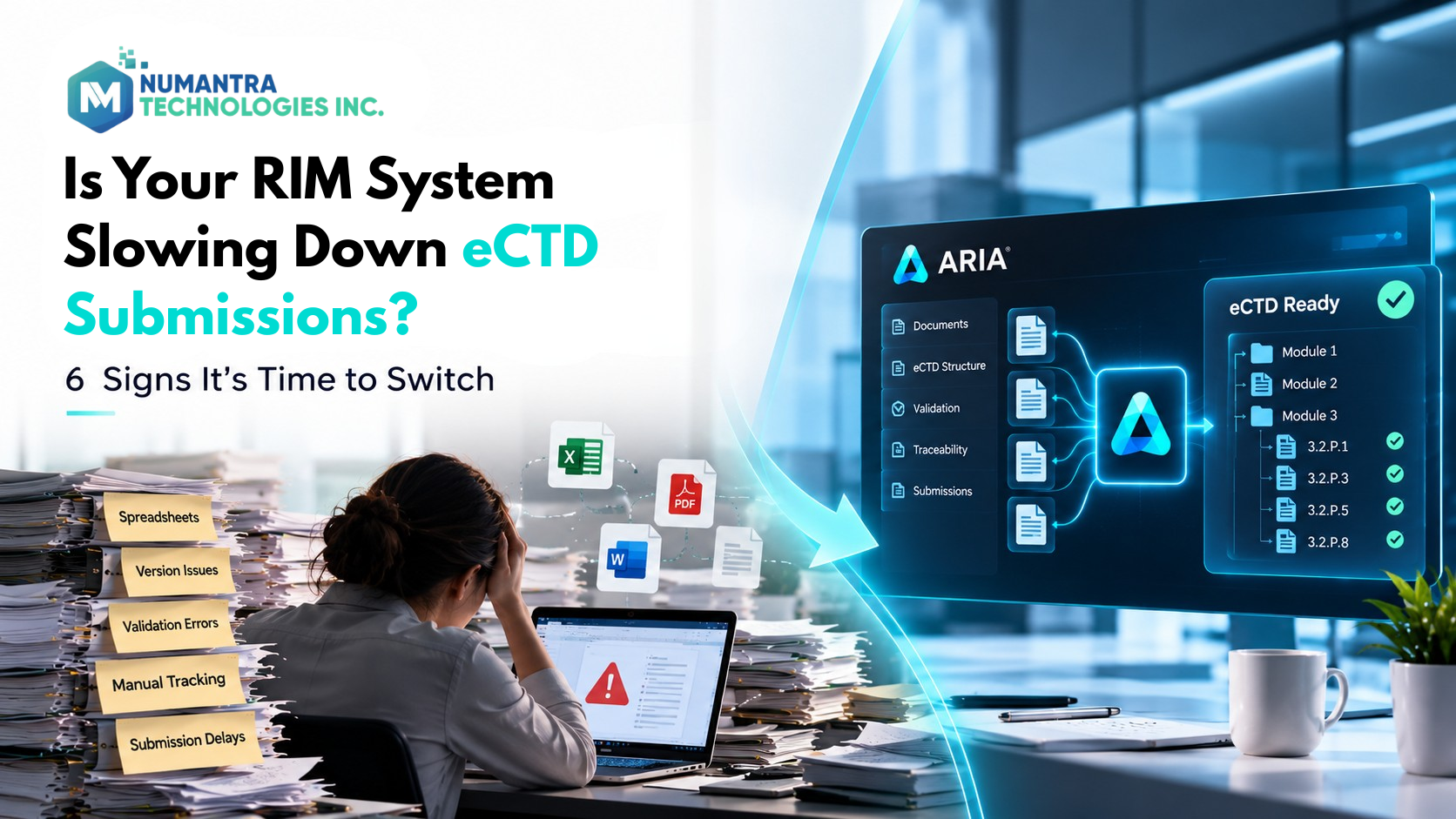
A regulatory information management (RIM) system is meant to make submissions safer and easier, not add another layer of work. But for many small pharma and biotech teams, the platform they rely on for eCTD submissions ends up doing the opposite, and RIM system eCTD submission delays start to feel routine. These problems tend to build up gradually, with extra manual work, version control issues, failed gateway checks, and submission timelines that keep stretching longer than planned.
If it feels like your team spends more time managing the RIM system than actually using it, you’re not imagining it, and it’s worth looking at the six signs below. The article also covers what a more connected alternative looks like, including the Knowledge Backbone NuMantra is building into its ARIA platform.
Sign 1: Your Team Relies on Spreadsheets Outside the System
When a RIM system works well, it serves as the main place for submission planning, document status, and regulatory timelines. When it does not, teams often set up extra tracking systems, such as spreadsheets for deadlines, shared drives for documents, and email threads for version updates.
This kind of shadow system is a clear sign that the platform is no longer meeting the team’s needs. It usually develops slowly, as small workarounds become part of the regular process, and in a regulated setting, that can cause data validity issues that surface during FDA inspections and audits.
Regulatory failures stemming from document fragmentation and disconnected tracking have been well-documented in the industry. Wolters Kluwer’s Regulatory Violations Intelligence Index recorded 199 regulatory violations in the first half of 2024 alone, totaling $1.876 billion in penalties. Not all of those stem from system gaps, but a significant portion traces back to data management practices that a modern RIM platform is designed to prevent.
Spreadsheets and shared drives also scatter the knowledge a team builds up over time. The reasoning behind a labeling change, the source data behind a Module 3 section, or the reviewer comment that prompted an amendment ends up in someone’s inbox or personal folder, and it leaves when that person does. ARIA’s Knowledge Backbone is being designed to connect source documents, prior submissions, reviewer comments, and decisions into one regulatory knowledge layer, so that history stays with the submission record.
Sign 2: eCTD Submissions Consistently Fail Gateway Validation
Gateway validation failures are one of the clearest signs of RIM system eCTD submission delays, and usually point to a publishing workflow that is not functioning properly. The FDA utilizes a commercial validation tool, currently the Lorenz eValidator, to assess incoming eCTD packages for compliance with technical requirements prior to initiating the review. If a submission does not pass this validation, it is returned to the sponsor for correction and resubmission, and each such instance adds further delay to the review process.
The categories of validation errors that cause gateway rejections are well established: broken hyperlinks, incorrect document granularity, misaligned XML structure, and naming convention violations. These are technical failures, not scientific ones. They occur when submission-building tools do not enforce correct structure, or when documents enter submission assembly without being checked against current FDA validation criteria. The real error is a system that doesn’t prevent those mistakes from happening in the first place.
NuMantra’s ARIA platform already uses AI-supported eCTD classification to place documents in the correct structure. Its Submission Intelligence capability, supported by the Knowledge Backbone, is designed to extend that into traceability and completeness checks, so structural gaps show up while the package is being assembled instead of after the FDA returns it.
The eCTD 4.0 transition makes this more acute. The FDA has updated its conformance validation criteria and controlled vocabulary releases multiple times through 2025 and 2026. A RIM system or publishing tool that doesn’t stay current with those updates will produce submissions that fail against criteria the team may not even know have changed.
Sign 3: Version Control Incidents Occur During Active Submissions
Version control is one of the core functions a RIM system exists to perform. When a team is assembling a submission and discovers that two versions of a clinical study report, a Module 2 summary, or a labeling document exist with no clear audit trail showing which is current, that’s a version control incident. In a submission context, it has direct consequences. The wrong version of a document in a filed package is a data validity deficiency that can trigger an information request or demand a sequence correction.
Version control incidents in active submissions point to one of three RIM system failures. The first is inadequate access controls. The second is the absence of automated version history. The third is a disconnect between the document management layer and submission assembly, meaning a document can be updated in one part of the workflow without correctly propagating to the submission package.
Small teams are particularly exposed to this risk because the same person often handles both authoring and submission assembly. Without a system that enforces version integrity at every handoff point, the gap between what a person believes is current and what is actually current becomes a submission liability.
Version control also depends on the system knowing how documents relate to one another. ARIA’s Knowledge Backbone is designed to record versions, prior submissions, and the relationships between them. That lets a team check what was filed in an earlier sequence and trace a document back to its source data.
Sign 4: Cross-Module Consistency Verifications Are Done Manually
Every eCTD submission requires that the content stay consistent across modules. FDA reviewers read the Module 2 summaries first, so any discrepancy with the underlying module data tends to trigger an information request.
If the team’s process for catching these inconsistencies is a manual comparison conducted in the final days before submission, two things are true. First, the team is absorbing a time cost that a modern RIM system should automate. Second, that check is more likely to miss something under deadline pressure than one built into the workflow continuously. When cross-module consistency work is done manually during submission assembly rather than managed systematically through a platform, costs go up without a corresponding improvement in submission quality.
Connected content makes this check possible earlier. ARIA’s Review Intelligence capability is designed to progressively flag missing information and inconsistencies across connected submission content. The Knowledge Backbone is also being built to match new content against historical submissions and correct it where the two disagree, so a Module 2 summary can be compared with the data it summarizes and with what was filed before.
Sign 5: The System Has No Readiness for eCTD 4.0
The FDA began accepting voluntary eCTD 4.0 submissions in September 2024. Japan’s PMDA made eCTD 4.0 mandatory from April 2026. The EMA began accepting v4.0 centralized applications on an optional basis in December 2025 and is targeting mandatory adoption within the 2026–2027 window.
Fewer than 15% of organizations had completed an eCTD 4.0 readiness assessment by the end of 2025. For small biotech teams using a RIM platform that hasn’t published a clear v4.0 roadmap, the transition risk isn’t theoretical but a timeline risk relative to deadlines already in effect for certain markets.
Sign 6: Submission Timeline Overruns Are Treated as Normal
Every regulatory team experiences the occasional submission delay. What matters is whether delays are incidents with identifiable root causes, or a consistent pattern the team has stopped questioning. When overruns become normalized, absorbed into project plans as expected reserve time rather than flagged as process failures, it’s usually because the underlying workflow has fundamental inefficiencies no one has formally traced back to the system.
A methodical evaluation should look at five things: whether the platform passes gateway validation consistently, whether it enforces version control automatically, whether it flags cross-module inconsistencies before submission, whether it already supports eCTD 4.0 authoring, metadata capture, and conformance validation against current FDA criteria, and whether it lets the team search, cite, and reuse information from previous submissions.
For teams evaluating the financial case, the ROI isn’t abstract. Faster, cleaner submissions reach the FDA for review sooner. Submissions that clear gateway verification on the first attempt skip the correction cycle entirely. And staff time recovered from manual workarounds goes straight into the next submission. Teams that can pull data from previous submissions, instead of hunting for it by hand, also spend less time preparing each new document. The calculation is concrete enough to model, which is exactly what a cost savings assessment is designed to do.
Where NuMantra’s ARIA Fits
Most of the signs above come back to one underlying problem. The information a regulatory team needs is spread across source documents, Module 3 sections, stability data, prior submissions, templates, and reviewer comments, and someone has to find and interpret it manually before it can be reused.
NuMantra’s ARIA platform currently provides OCR-based document understanding, AI-supported authoring, and eCTD classification. NuMantra is now building a Knowledge Backbone that connects those capabilities to a shared layer of regulatory content, submission structure, source evidence, versions, and relationships. It is designed to let teams:
- Search across previous submissions and cite the documents that support new content.
- Generate new documents using data from previous submissions or from external sources.
- Match new content against historical submissions and correct inconsistencies before filing.
- Keep the history of source information, generated content, manual changes, and decisions available after people or projects change.
Human review stays part of the process. The Knowledge Backbone is meant to cut the time teams spend searching and to improve traceability back to source evidence, with regulatory professionals still making the final calls.
Conclusion
A RIM system that needs your team to work around its gaps isn’t really a submission management platform but a source of submission risk. Each of the six signs above represents a category of RIM system eCTD submission delays that’s avoidable with the right platform in place.
NuMantra Technologies is built for regulatory teams that have outgrown the platforms they started with: an AI-first submission workspace that brings authoring, validation, and eCTD publishing together, with the metadata controls and conformance standards small pharma and biotech teams need to file accurately and on time. Its ARIA platform is also being extended with a Knowledge Backbone designed to connect prior submissions, source evidence, and regulatory decisions, so teams can search, reuse, and check their past work instead of rebuilding it for every filing. Try the Cost Savings Calculator at numantratech.com to see what a faster, cleaner submission workflow could mean for your pipeline.
References
1. https://www.mckinsey.com/featured-insights/week-in-charts/pharma-submission-speedup
2. https://assets.contenthub.wolterskluwer.com/api/public/content/2448875-wolters-kluwer-regulatory-violations-intelligence-index—september-2024-pdf-8d957e04fe
3. https://www.pharmexec.com/view/optimizing-pharma-content-for-faster-product-submissions
4. https://www.vigilarebp.com/blogs/ectd-trends-in-2026-essential-updates-for-cmc-pv-clinical-teams/
5. https://intuitionlabs.ai/articles/rim-systems-biotech-guide
6. https://intuitionlabs.ai/articles/rim-systems-idmp-standards-guide
7. https://www.fda.gov/drugs/electronic-regulatory-submission-and-review/ectd-submission-standards-ectd-v40-and-regional-m1
8. https://www.ema.europa.eu/en/documents/report/report-joint-hma-ema-multi-stakeholder-workshop-submission-predictability_en.pdf
9. https://www.mckinsey.com/industries/life-sciences/our-insights/rewiring-pharmas-regulatory-submissions-with-ai-and-zero-based-design
10. https://www.dnxtsolutions.com/2026/01/09/regulatory-operations-report/
Frequently Asked Questions
What is a RIM system and why does it matter for eCTD submissions?
A regulatory information management (RIM) system is a software platform that centralizes the management of regulatory documents, correspondence with regulatory agencies, and product registration data across markets. For eCTD submissions specifically, a RIM system provides the document management, version control, and submission tracking that enables compliant package assembly. Without a functional RIM platform, teams manage these activities across disconnected tools (a common root cause of RIM system eCTD submission delays), which introduces version divergence, missed deadlines, and audit trail gaps that can affect inspection findings.
How do I know if our eCTD submission delays are caused by the RIM system or by upstream data issues?
When delays happen during document assembly, submission packaging, or gateway validation, the RIM system and its connected publishing tools are the likely source. If postponements originate earlier, the constraint sits upstream of the submission platform. Many teams find that both exist simultaneously, but the RIM-related delays are the ones most directly addressable through a platform change.
What should a RIM system do to support eCTD 4.0 submissions?
A RIM system that supports eCTD 4.0 should enable metadata capture at the stage of authoring rather than at submission assembly. Teams should ask vendors for specific confirmation of v4.0 support, including which aspects of the unified XML architecture and controlled vocabulary management are handled natively versus requiring manual configuration.
Is it possible to migrate to a new RIM system mid-submission cycle?
It’s possible, but the risk is higher than migrating between submission cycles. The validation timeline for a new regulated system typically runs three to six months, meaning the practical minimum lead time for a clean transition is at least one submission cycle ahead of when the new platform is needed in production.
What is the difference between a RIM system and an eCTD publishing tool?
A RIM system manages the full regulatory lifecycle. An eCTD publishing tool handles the assembly of submission packages, such as generating the XML, enforcing folder structure, applying document metadata, and running validation checks. Some platforms integrate both functions in a single environment, while others require separate tools. The gap between a disconnected RIM and publishing tool is a common source of workflow friction, particularly when a version-controlled document in the RIM system doesn’t automatically reflect its correct state in the publishing tool.
Can a RIM system help teams reuse content from previous submissions?
Most RIM systems store past submissions, but finding and reusing specific data from them is usually a manual search. NuMantra’s ARIA is being built with a Knowledge Backbone designed to let teams search and cite across previous submissions, generate new documents from prior submission data or external sources, and match new content against historical submissions to catch inconsistencies. A regulatory professional still reviews the output before anything is filed.