Introducing ARIA: AI for Regulatory Intelligence & Authoring, our new AI agent, built on everything you already know from NuMantra.
June 8, 2026
admin
Manual vs. Automated eCTD Publishing: A Side-by-Side Breakdown for RA Teams
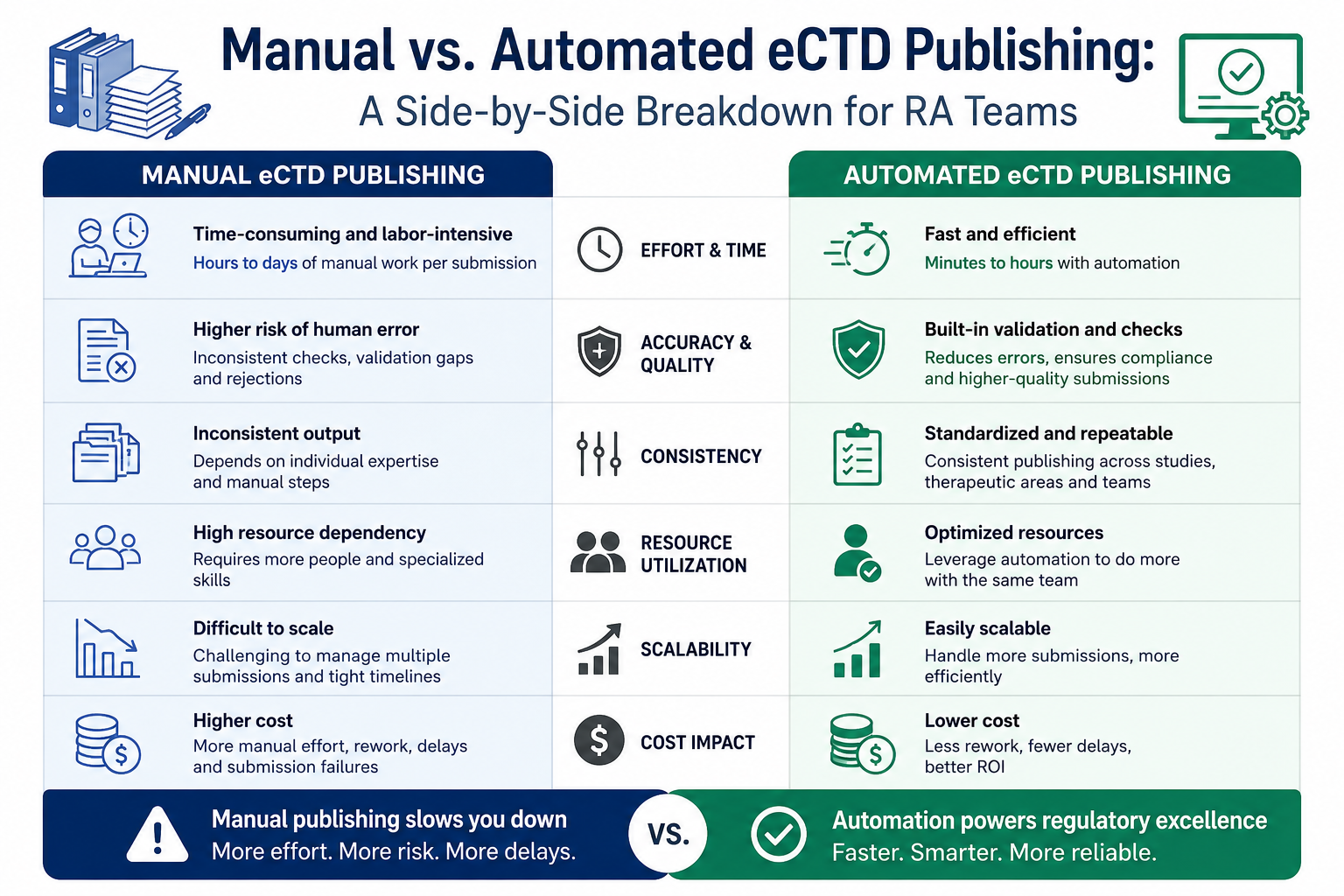
Manual eCTD publishing puts the burden of structure, validation, and lifecycle tracking entirely on your team. Automated publishing shifts that burden to predefined rules and system logic, so your regulatory staff can focus on compliance decisions rather than formatting checks. For RA teams managing IND, NDA, and BLA timelines, that difference has a direct impact on submission readiness and technical rejection risk.
The electronic common technical document (eCTD) is the standard format for submitting applications, amendments, supplements, and reports to the FDA’s CDER and CBER. Because eCTD submissions must follow a strict structure, use valid file formats, support working navigation, and maintain correct lifecycle management across sequences, publishing is a compliance control point, not just an administrative step.
How the Two Workflows Actually Differ
The core distinction between manual and automated eCTD publishing is not speed but consistency. Manual workflows require individual attention for every check, sequence, and submission. Automated workflows apply the same rules every time and flag the exceptions for human review.
| Manual Publishing Setup | Automated Publishing Setup |
|---|---|
| Opening files individually to review formatting and properties | Applying configured publishing rules across document batches |
| Checking bookmarks and hyperlinks by hand | Running validation checks against current FDA criteria before submission |
| Tracking lifecycle changes in spreadsheets | Generating and maintaining submission structure from controlled metadata |
| Managing review status across email threads and shared folders | Centralizing review status and approval tracking |
| Repeating QC checks in the final hours before dispatch | Flagging exceptions for regulatory review instead of requiring exhaustive manual checks |
The regulatory judgment stays with your team. What changes is how much of their time goes to formatting, tracking, and repeat QC work.
Document Preparation and Formatting
Every eCTD sequence depends on source files that meet FDA technical requirements. A formatting error in the draft, including incorrect PDF settings, unsupported file type, or missing metadata, can create problems when the sequence is assembled and validated.
Manual preparation works for small packages. For submissions with hundreds or thousands of files, the risk profile changes. Fatigue, version confusion, and late-stage edits increase the likelihood that something gets missed.
Automated publishing applies predefined rules to standardize document preparation before the final sequence is generated. It flags missing metadata, incorrect naming conventions, unsupported formats, and structural gaps early, before those issues compound. Because FDA validation criteria are updated periodically, RA teams need a preparation process that keeps pace with current technical requirements.
Hyperlinks, Bookmarks, and Reviewer Navigation
A submission that is technically valid but poorly navigated still creates problems for reviewers and, by extension, for your timeline. Clinical summaries, study reports, appendices, literature references, and datasets all need to be linked and bookmarked in a way that supports efficient review.
Manual hyperlinking introduces specific risks:
- Links leading to the wrong page or section
- Bookmarks that do not match the document’s heading structure
- Late document changes that break existing links without detection
- Reviewer time wasted navigating a poorly structured file
Automated publishing tools can identify cross-references, build links consistently, and verify destinations against the final document set. That said, automation still requires oversight. RA teams should review navigation in high-risk documents and check any files that were revised late in the process, since late changes are the most common source of broken links.
XML Backbone and Submission Structure
The XML backbone tells the receiving agency system how the submission is organized. It connects content files, metadata, sequence information, and lifecycle instructions into a machine-readable structure that agencies use to process and route submissions.
Managing the XML manually becomes increasingly risky as sequences accumulate. Publishers must add, replace, append, or delete files while maintaining correct relationships to prior sequences. An incorrect lifecycle operation can create ambiguity about which document version is current, which can trigger a technical refusal to file or require a corrective resubmission.
Automation reduces this risk by generating or updating the submission structure from controlled inputs. It also tracks file relationships across sequences, which is particularly useful when your team is working on multiple amendments, supplements, or regional variations simultaneously.
Lifecycle Management After the First Submission
Lifecycle management is where manual processes tend to break down, not at the first submission, but over time.
After the initial filing, your team will continue to submit amendments, information request responses, annual updates, safety reports, and labeling changes. Each of those sequences builds on the last. In manual workflows, tracking what was submitted, what replaced what, and what the current operative document is typically falls to spreadsheets and institutional memory. When team members turn over, or multiple sequences are produced in parallel, that creates risk.
Automated lifecycle tracking maintains a structured record of prior submissions and flags whether a document should be treated as new, replaced, appended, or deleted. This does not eliminate the need for regulatory review of those decisions. It does reduce the chance that a lifecycle decision is made based on incomplete or outdated information.
Validation and Technical Rejection Risk
The FDA requires sponsors to validate eCTD submissions against published technical specifications before filing. A sequence that does not meet those requirements can be refused at intake before a substantive review even begins.
In manual workflows, validation typically happens late, after the documents are already assembled. At that point, any issues require the team to revise files, update metadata, regenerate the sequence, and repeat QC under deadline pressure.
Automated validation runs earlier and covers a defined set of technical checks:
- Missing or misplaced files
- Incorrect metadata
- Broken hyperlinks
- Unsupported file formats
- Lifecycle inconsistencies
The key is timing. Catching these issues before the submission window becomes critical gives the team time to fix them without rework cascades. It also reduces dependence on one or two experienced publishers who know where the problems typically hide.
AI Skepticism in Regulatory Publishing
RA leaders are right to be cautious about AI in compliance workflows. A tool that generates unreviewed text or modifies regulated content creates regulatory risk that no efficiency gain can offset. That skepticism is appropriate, and it is worth being precise about what kind of automation is actually being described.
Three categories are worth distinguishing:
- Generative AI creates or rewrites content: This is the category that warrants caution in regulated submissions
- Operational automation applies configured rules to existing content and process steps: This is what eCTD publishing tools do
- Human-in-the-loop systems maintain human oversight and approval authority throughout: This is what compliant regulatory workflows require
The automation relevant to eCTD publishing is operational, not generative. It does not write your clinical summaries or alter your submission content. It validates structure, checks files against technical requirements, tracks lifecycle history, and surfaces exceptions for human review. The regulatory call remains yours.
When evaluating any platform, verify this distinction directly. Ask specifically what the system generates versus what it validates, and where human approval is required before a sequence is released.
Audit Trails and Oversight
In a manual publishing environment, the evidence trail is often fragmented: spread across emails, shared drives, chat messages, and individual files. If an inspection or internal audit requires you to reconstruct who approved a document and when, that reconstruction can be time-consuming and incomplete.
Automated systems centralize activity logs, review history, and approval records in a single location. RA leaders get clearer visibility into submission status and accountability. Before selecting any system, confirm that its audit trail functionality aligns with your internal SOPs and compliance requirements, since not all platforms implement this equivalently.
Audit Trails and Oversight
In a manual publishing environment, the evidence trail is often fragmented: spread across emails, shared drives, chat messages, and individual files. If an inspection or internal audit requires you to reconstruct who approved a document and when, that reconstruction can be time-consuming and incomplete.
Automated systems centralize activity logs, review history, and approval records in a single location. RA leaders get clearer visibility into submission status and accountability. Before selecting any system, confirm that its audit trail functionality aligns with your internal SOPs and compliance requirements, since not all platforms implement this equivalently.
Global Submission Complexity
For teams managing submissions across multiple regions, the complexity compounds. Core clinical content may be shared, but Module 1 requirements, regional forms, local metadata standards, and lifecycle expectations vary by healthy authority.
Manual approaches to global submissions typically result in duplicate file sets and separate country-level trackers, which increases version risk as sequences evolve. Automated workflows can separate region-specific requirements from the shared content base, reducing duplication and the chance that a regional version falls out of sync with the core package.
The FDA has also published implementation guidance from eCTD v4.0, indicating that technical standards continue to evolve. Teams managing global submissions need a process that can accommodate those changes without requiring a full workflow rebuild.
What to Know Before Moving to Automation
A transition from manual to automated eCTD publishing is a process change, not a software installation. Treating it as the latter is one of the most common reasons implementations underperform. Historical sequences, existing templates, metadata structures, and approval workflows need to be mapped before configuration begins.
A sound transition plan covers:
- Review your current submission inventory and identify recurring errors and bottlenecks.
- Map existing templates, metadata, and lifecycle records.
- Configure workflows against current agency requirements.
- Train users on publishing rules and exception handling.
- Run a parallel test sequence before going live.
- Review test output against internal quality standards before switching over.
The transition touches regulatory operations, quality control, document management, and submission governance. It requires cross-functional planning, not just a vendor onboarding call.
What Can Still Go Wrong With Automation
Automated publishing reduces manual workload, but it does not eliminate the need for regulatory judgment. The most common failure modes are not system failures but process-related:
- Poor source document quality that the system cannot compensate for
- Incorrect metadata mapping that produces structurally valid but substantively wrong output
- Overreliance on automated validation, missing issues that require human review
- Insufficient user training on exception handling
- Failure to update configured workflows when agency requirements change
- Inadequate review of exception reports generated by the system
Automation works best when it is paired with defined human review checkpoints. The system flags what needs attention, and the RA team decides what to do about it.
Conclusion
The practical difference between manual and automated eCTD publishing is accountability. Manual workflows concentrate responsibility for formatting, validation, lifecycle tracking, and QC in a small number of people, under deadline pressure, with limited documentation of what was checked and when. Automated workflows distribute that responsibility between the system and the team, with the system handling the repeatable checks and the team owning the regulatory decisions.
For RA leaders managing IND, NDA, and BLA timelines, the question is not whether automation is worth evaluating. It is whether your current process can sustain its workload, maintain its accuracy, and document its decisions at the volume your pipeline requires.
NuMantra Technologies is a regulatory operations platform that supports eCTD authoring, validation, publishing, and submission tracking within a single workspace. When evaluating tools, look beyond submission speed. Assess whether the platform provides controlled workflows, a complete audit trail, current validation criteria, and a defined point at which human review occurs before a sequence is submitted.
Book a demo today.
FAQs
1. Is eCTD mandatory for FDA submissions?
The FDA identifies eCTD as the standard format for many electronic submissions to CDER and CBER. Requirements can vary by submission type and timing. Sponsors should verify current FDA guidance before preparing each sequence.
2. What is the difference between eCTD publishing and eCTD validation?
Publishing is the process of assembling documents, metadata, navigation, and lifecycle information into a submission sequence. Validation checks whether that sequence meets the technical specifications required for acceptance. The two are related but not interchangeable. A published sequence is not automatically a valid one.
3. How does lifecycle management differ between manual and automated eCTD workflows?
Manual lifecycle tracking typically relies on spreadsheets and team familiarity with prior sequences, which creates risk when personnel change or multiple sequences are in progress simultaneously. Automated systems maintain a structured record of submissions and flag whether each document should be classified as new, replaced, appended, or deleted, reducing the chance of lifecycle errors reaching submission.
4. What are the limits of automated validation?
Automated validation catches defined technical errors, such as missing files, broken links, incorrect metadata, and unsupported formats. It does not perform a substantive regulatory review of submission content or evaluate submission strategy. Teams that treat automated validation as a substitute for regulatory judgment will miss issues that fall outside the system’s programmed checks.
5. How does regional submission complexity affect eCTD publishing?
Module 1 requirements, regional forms, metadata standards, and lifecycle expectations vary by health authority. Managing those variations manually typically means maintaining separate file sets and trackers for each region, which increases version risk as the submission evolves. Automated workflows can isolate region-specific requirements from the shared content base, reducing duplication and the risk of regional versions falling out of sync.
References
- S. Food and Drug Administration. Electronic common technical document (eCTD). Silver Spring (MD): FDA; 2024. Available from: https://www.fda.gov/drugs/electronic-regulatory-submission-and-review/electronic-common-technical-document-ectd
- S. Food and Drug Administration. Electronic regulatory submission and review. Silver Spring (MD): FDA; 2025. Available from: https://www.fda.gov/drugs/forms-submission-requirements/electronic-regulatory-submission-and-review
- S. Food and Drug Administration. Specifications for eCTD validation criteria. Silver Spring (MD): FDA; 2025. Available from: https://www.fda.gov/media/87056/download
- S. Food and Drug Administration. eCTD technical conformance guide. Silver Spring (MD): FDA; 2022. Available from: https://www.fda.gov/media/93818/download
- S. Food and Drug Administration. eCTD submission standards for eCTD v4.0 and regional M1. Silver Spring (MD): FDA; 2026. Available from: https://www.fda.gov/drugs/electronic-regulatory-submission-and-review/ectd-submission-standards-ectd-v40-and-regional-m1
- S. Food and Drug Administration. eCTD submission standards for eCTD v3.2.2 and regional M1. Silver Spring (MD): FDA; 2025. Available from: https://www.fda.gov/drugs/electronic-regulatory-submission-and-review/ectd-submission-standards-ectd-v322-and-regional-m1
- International Council for Harmonisation of Technical Requirements for Pharmaceuticals for Human Use. ICH M8: electronic common technical document eCTD v4.0. Geneva: ICH. Available from: https://ich.org/page/ich-electronic-common-technical-document-ectd-v40
- International Council for Harmonisation of Technical Requirements for Pharmaceuticals for Human Use. ICH M8: specification for submission formats for eCTD. Geneva: ICH. Available from: https://www.ich.org/page/ich-m8-specification-submission-formats-ectd
- International Council for Harmonisation of Technical Requirements for Pharmaceuticals for Human Use. Electronic common technical document eCTD v3.2.2 specification and related files. Geneva: ICH. Available from: https://www.ich.org/page/ich-electronic-common-technical-document-ectd-v322-specification-and-related-files
- NuMantra Technologies. eCTD submissions and digital solutions: automation and analytics. NuMantra Technologies. Available from: https://numantratech.com/