Introducing ARIA: AI for Regulatory Intelligence & Authoring, our new AI agent, built on everything you already know from NuMantra.

June 8, 2026
admin
ROI of AI in Regulatory Affairs: The Metrics VPs Use to Justify the Budget
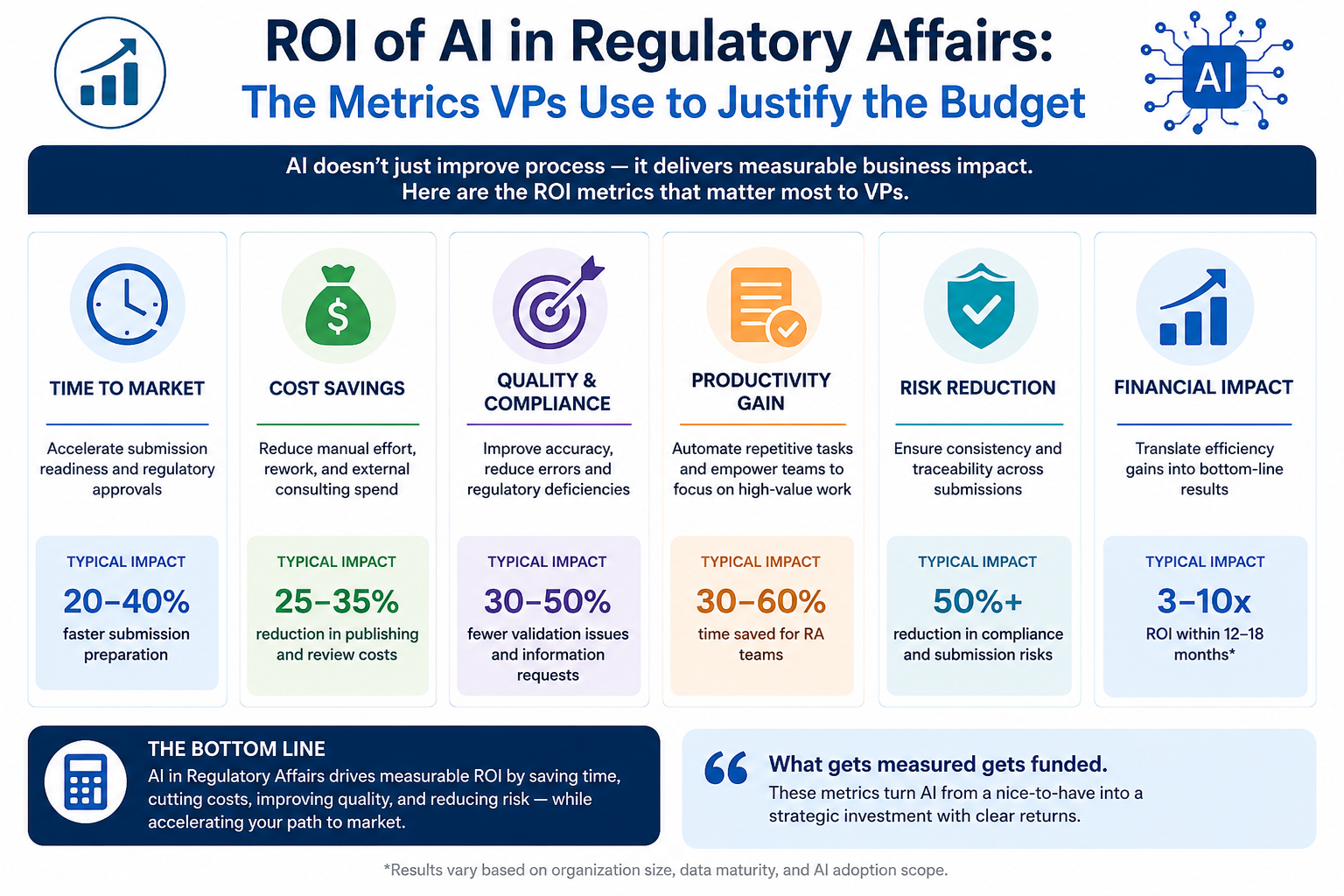
Technology conversations in regulatory affairs usually begin the same way. Someone promises fewer manual steps, shorter timelines, and better productivity. A few months later, the discussion changes. Teams want to know where the savings appeared, whether submission work actually became easier, and whether the investment changed anything beyond adding another system to manage.
Regulatory leaders are often expected to answer those questions with numbers, and that is where many business cases stall. The challenge is rarely a lack of data. Submission timelines, QC findings, publishing effort, amendment cycles, and project hours exist across trackers, spreadsheets, and project records. The issue is that the data was never collected with ROI measurement in mind.
Finance teams do not approve budgets because a process feels more efficient. They look for evidence tied to cost, workload, and measurable operational change. The question is not whether AI can help regulatory teams work differently. The more practical question is whether those improvements can be measured in a way that survives budget review.
Why ROI Is Difficult to Quantify in Regulatory Affairs
Regulatory work creates value differently compared to revenue-generating functions. Teams see it when a filing moves forward without technical issues, when a review cycle avoids unnecessary rework, or when a submission stays on schedule despite competing priorities. Many of the benefits appear as costs that never materialized. A clean submission has value, but measuring it requires understanding what would have happened if the submission had required correction or amendment.
The second challenge is that savings rarely appear in a single activity. A reduction in formatting work might save hours for publishing teams. Fewer technical issues may reduce repeated QC cycles. Better document consistency can lower downstream correction work. Small gains often appear across different functions and at different stages of the process.
Teams that build stronger business cases usually start with a different question: where is work accumulating today? The answer often produces more useful information than beginning with assumptions about future savings.
The Metrics Regulatory Leaders Rely On
Four categories of measurement appear consistently in regulatory AI business cases that survive internal scrutiny. Each addresses a different cost driver and speaks to a different stakeholder concern.
Labor Hours Recovered
Labor savings are often the first metric reviewed because they are easier to connect to existing workflows. The useful approach is to look at recent submissions of the same type and examine where time was actually spent. Hours often accumulate in document preparation, repeated QC work, publishing support, hyperlink updates, and cross-reference checks following late content changes. Those activities produce a more reliable baseline than estimating savings across the total submission effort.
The calculation should use the loaded FTE cost rather than salary alone. Benefits, overhead allocation, and organizational costs can materially change the final estimate.
Submission Cycle Time
Cycle time is the interval from decision-to-submit to actual filing. Shortening it carries financial implications proportional to the program stage. For a late-stage NDA approaching approval, each day of delay has a calculable market value. For an early IND, the cost is primarily internal labor and schedule impact on connected workstreams.
Track this in days per submission type across a consistent sample. Any cycle time improvement presented in a business case should include the deficiency rate data alongside it. A submission filed faster but with more errors is not an efficiency gain. It transfers cost forward into the amendment cycle, which tends to be more disruptive than the time saved in preparation.
Rework and Deficiency Cost
Deficiency cycles are systematically undertracked because their costs accumulate across multiple teams and fiscal periods. A technical deficiency on an NDA may require 20 hours of regulatory affairs time, 10 hours of project management coordination, and 5 hours of clinical or medical input to resolve. Only the regulatory affairs portion typically appears in any budget analysis.
FDA’s guidance on refuse-to-file (RTF) actions identifies electronic submission deficiencies, including eCTD structural errors, broken hyperlinks, and missing bookmarks, as issues that can trigger an RTF action even when the application’s scientific content is complete. These are not scientific errors. There are structural and formatting problems that a validation tool can catch before submission. The ROI of catching them is the avoided cost of the rework cycle that follows when they are not.
Track deficiency volume by type over time, separating technical and formatting issues from content-related ones. Calculate average resolution hours per deficiency type. This number becomes the avoided-cost input once AI reduces deficiency rates.
Regulatory Team Capacity
Regulatory teams routinely manage submission volumes that grow faster than headcount, particularly at growth-stage biotech organizations scaling toward a first NDA or BLA. If AI tooling allows a team to absorb additional submission volume without adding headcount, the ROI includes both avoided hiring costs and the ability to advance more programs on the same schedule. This category is most relevant for teams facing projected volume growth. For those managing a fixed pipeline with no near-term expansion, the business case should reflect that honestly.
Why Pharmacovigilance Needs a Different ROI Approach
The ROI of AI in pharmacovigilance quantification does not follow the same logic as submissions work, and applying the same framework produces misleading results.
Submission work moves through defined milestones and delivery dates. Pharmacovigilance is continuous. Case volume changes over time, reporting deadlines remain fixed, and workload continues regardless of other priorities. Because of this, ROI cannot be measured only by time saved. The more useful indicators are tied to operational throughput and compliance pressure:
- ICSR processing time per case, from intake to submission
- Case backlog volume at regular intervals in the reporting cycle
- MedDRA coding accuracy
- Expedited reporting compliance against 7-day and 15-day deadlines
- Time required for PSUR and PBRER preparation
The real question is whether teams can reduce repetitive case-handling work without creating additional review burden or compliance risk downstream. Expedited reporting deadlines carry enforcement consequences. Both FDA and EMA have mechanisms for addressing late or missing ICSRs, and those consequences can extend to broader program-level scrutiny in aggregate.
Published evidence on AI in pharmacovigilance is growing but uneven. A 2025 review in Therapeutic Advances in Drug Safety found consistent potential for improving case processing throughput and signal detection, while noting that practical implementation remains constrained by data quality issues, regulatory acceptance requirements, and the need for transparent, auditable outputs. Results vary considerably by implementation context. Direct measurement against your own baseline is more defensible than extrapolating from published figures.
Factors That Can Change the Outcome of an ROI Calculation
ROI projections that look defensible on paper and disappoint in practice usually fail for predictable reasons.
Validation Requirements
AI tools used in regulated submission workflows require validation proportional to their function and risk classification. FDA’s guidance on computer software assurance for production and quality management systems provides a risk-based framework for software used in production and quality systems. Tools that generate submission-ready content or substitute automated checks for manual review fall within its scope. For tools used to support regulatory decision-making on safety or effectiveness, the FDA’s January 2025 draft guidance on the use of AI in drug and biological product development is also directly relevant.
Validation effort is a real cost that belongs on the investment side of the formula. Teams that omit it typically discover the gap during implementation.
Implementation and Training Costs
The license cost is typically the smallest component of the total first-year investment. System configuration, integration with existing document management infrastructure, and workflow redesign in regulated environments, where every process change requires documentation, frequently exceed it. Training time has two components: direct onboarding hours and the productivity reduction during the period when staff can use the tool but are not yet efficient with it. Both belong in the year-one cost figure.
Scoping the Savings Correctly
The most common distortion in regulatory AI ROI calculations is applying a single efficiency percentage to total submission hours rather than to the specific tasks the tool handles. If an AI tool reduces formatting and validation time by 40% but has no effect on scientific authoring, and scientific authoring represents 60% of total submission hours, the effective reduction on total hours is 16%, not 40%. Scoping the calculation to the affected task set yields a smaller but substantially more defensible headline number. It also tends to hold up better when the finance team asks for the methodology.
The Bottom Line
Stronger investment decisions are usually built on internal evidence rather than broad assumptions. Understanding where time is being spent, where rework repeatedly occurs, and where submission or reporting pressure creates bottlenecks often provides a clearer picture than projected productivity gains alone.
If you want to estimate potential impact using your own submission activity and labor inputs, NuMantra Technologies’ Cost Savings Calculator can help translate those workflow patterns into a practical estimate.
Frequently Asked Questions
1. Which activities in regulatory submissions usually consume more time than teams initially expect?
Many teams assume the greatest effort sits in authoring, but time often accumulates later in the process. Late document revisions can trigger a chain of downstream work that includes updating hyperlinks, checking cross-references, rebuilding tables of contents, rerunning quality checks, and reviewing changes across multiple modules. During larger submissions, these activities can consume substantial effort even though they add little scientific value.
2. Where do regulatory teams usually see measurable value when AI is introduced?
The earliest impact often appears in repetitive work that follows established rules, including document consistency checks, identification of missing references, formatting reviews, and quality-control tasks that require repeated manual inspection. Scientific interpretation and submission strategy remain dependent on human review.
3. What costs are often overlooked during ROI calculations?
The obvious cost is usually the software itself. Less visible effort appears later: validation activities, onboarding time, workflow updates, and internal review. Organizations also often underestimate the work involved in preparing templates, historical content, and document libraries before a new system can operate reliably.
4. How should organizations evaluate AI tools before broader implementation?
A narrow pilot generally provides more useful information than a large rollout. Teams often choose a single submission type or activity with a recurring workload, then measure time and effort before and after implementation. Small pilots usually make it easier to determine whether measurable differences are actually related to the tool.
References
- S. Food and Drug Administration. Refuse to File: NDA and BLA Submissions to CDER — Guidance for Industry. December 2017. Docket No. FDA-2017-D-6554. Available at: https://www.fda.gov/media/109758/download
- Nagar A, Gobburu J, Chakravarty A. Artificial intelligence in pharmacovigilance: advancing drug safety monitoring and regulatory integration. Therapeutic Advances in Drug Safety. 2025;16. DOI: 10.1177/20420986251361435
- S. Food and Drug Administration. Computer Software Assurance for Production and Quality Management System Software — Guidance for Industry and FDA Staff. February 2026. Docket No. FDA-2022-D-0795. Available at: https://www.fda.gov/media/188844/download
- S. Food and Drug Administration. Considerations for the Use of Artificial Intelligence to Support Regulatory Decision-Making for Drug and Biological Products — Draft Guidance for Industry. January 2025. Docket No. FDA-2024-D-4689. Available at: https://www.fda.gov/media/184830/download