
- CMC Module 3 authoring
CMC narratives that write themselves. Almost.
Module 3 authoring takes weeks because your data lives in LIMS, spreadsheets, and legacy documents that nobody wants to touch. NuMantra pulls it together, generates the narratives, and hands you a reviewer-ready draft — not a blank template.
Less time on Module 3 prep
All major CMC sections covered
Regional rule sets built in
Module 3 is the most labour-intensive section. That's not an opinion.
A single NDA can require hundreds of CMC documents. Most of the time spent on them is copy-paste, reformatting, and chasing version history – not actual science.
Most AI authoring tools assume your data arrives clean and structured. It doesn't. LIMS exports, scanned batch records, and merged PDFs with inconsistent formatting need to be parsed and reconstructed before any narrative can be generated accurately. Without a dedicated OCR and data retrieval layer, AI hallucinates or requires extensive manual correction — defeating the purpose.
Solved by NuMantra's proprietary OCR engine
Aligning drug product specifications with QbD principles, checking batch records against analytical reports - all done manually across separate systems.
No single source of truth. Writers pull from wherever they can find the data, introducing version mismatches and inconsistencies between sections.
A manufacturing change or updated specification means touching sections 3.2.S, 3.2.P, and QOS — manually, across multiple documents.
FDA, EMA, and PMDA have different granularity requirements. Teams reformat the same CMC content multiple times for each market submission.
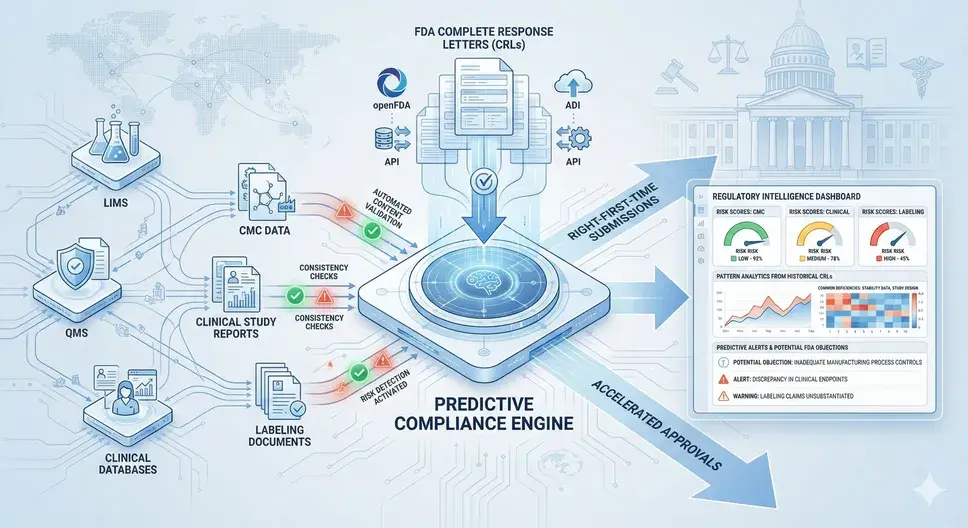
The platform extracts, maps, and writes. Your team reviews, approves, and submits. That’s the division of labour it should be.
IDP extracts batch data, stability tables, and spec sheets from PDFs and LIMS exports
AI maps extracted data to correct CTD section nodes (3.2.S, 3.2.P, 2.3 QOS)
Narrative drafts are generated using your approved language library
Change in one section triggers tracked updates to all dependent sections
Regional rule sets reformat for FDA, EMA, PMDA, and Health Canada automatically
What NuMantra actually handles
Six things your team is doing by hand right now.
- Proprietary engine
OCR processing & structured data retrieval
Every accurate Module 3 narrative starts with clean, structured source data. NuMantra’s proprietary OCR engine parses raw files — scanned PDFs, LIMS exports, merged documents — extracting not just text, but structure. Tables, headers, section boundaries, and data relationships are all preserved and mapped to the correct CTD nodes before the AI authors a single section.
Captures document geometry alongside content — tables, columns, and heading hierarchy intact
LIMS exports, merged PDFs, and CMC templates processed directly — no manual pre-formatting
Structured data fed to the draft agent means first-draft accuracy — not hallucinated output that needs rewriting
AI drafts Module 3 section narratives using your existing approved language, batch data, and regulatory templates. First draft in hours, not days
When a specification changes, NuMantra flags every downstream section that references it — 3.2.S, 3.2.P, QOS, and the backbone — and queues them for review.
Pulls stability data from LIMS exports or uploaded study reports, formats them to ICH Q1E requirements, and slots them into the correct CTD nodes.
Insert pre-approved language blocks with full audit trail. Every reused block is traceable to its source document and approval date.
The same CMC content packaged for FDA, EMA, PMDA, and Health Canada in one workflow. Regional granularity rules applied automatically at export.
Hyperlink integrity, metadata completeness, and cross-reference checks run while you work — not as a batch job that fails at 11pm the night before submission.
From source data to submission-ready CMC in four steps
No rip-and-replace. NuMantra works with what you already have.
- 1
- 2
- 3
- 4
What actually changes
Not claims. Specific differences in how the work gets done.
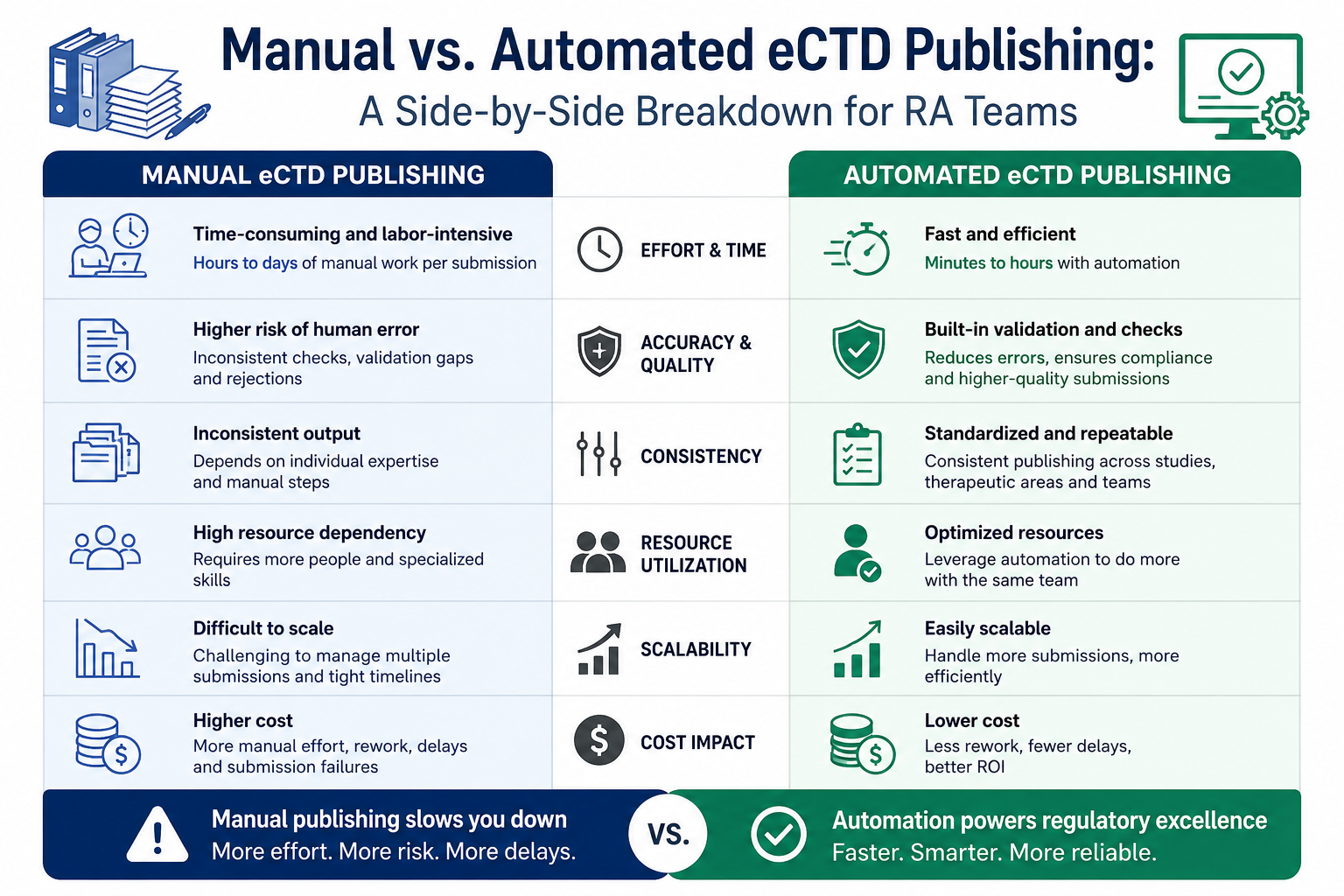
| Task | Manual process | With NuMantra |
|---|---|---|
| Raw file processing & OCR | Manually copy data from PDFs, re-enter table values, interpret scanned docs by hand — before writing can even begin | Proprietary OCR engine ingests raw files, extracts structured data and layout — clean inputs ready for AI in minutes |
| Module 3 first draft | 2–4 weeks of writer time | Same-day AI draft, 1–2 days review |
| Stability data formatting | Manual extraction from LIMS reports | Auto-extracted and formatted to ICH Q1E |
| Specification change impact | Writer hunts through all sections manually | System flags all affected sections instantly |
| Multi-regional formatting | Separate reformatting per market (weeks) | Single workflow, regional rules applied at export |
| Hyperlink validation | Manual check before compile — often missed | Inline, real-time, as you author |
| Audit readiness | Reconstruct from email trails and file history | Full audit log, e-signatures, and version history built in |
Things people ask before booking a demo
CMC (Chemistry, Manufacturing, and Controls) authoring covers the quality documentation in Module 3 of the CTD/eCTD — drug substance (3.2.S), drug product (3.2.P), the Quality Overall Summary (2.3 QOS), stability summaries, impurity profiles, and specifications. It's the most technically dense and time-consuming section of any regulatory submission.
1. OCR processing & data retrieval — NuMantra's proprietary OCR engine ingests raw source files: LIMS exports, scanned batch records, merged PDFs, and CMC templates. It extracts structured data — tables, specifications, stability results — preserving layout context so nothing is lost or misread.
2. AI narrative generation — the draft agent writes Module 3 sections against the structured data from step 1, aligned to ICH M4Q(R1) guidelines and drawing from your approved language library. Because the inputs are clean and accurate, first drafts are reviewer-ready — not a starting-point guess. A regulatory writer reviews and approves before anything is finalised.
3.2.S (drug substance), 3.2.P (drug product), 2.3 QOS (Quality Overall Summary), stability summaries per ICH Q1E, impurity profiles per ICH Q3A(R2), and specification tables. If you need a section we don't currently cover, that's a conversation worth having.
NuMantra connects via API to common platforms and accepts LIMS exports in standard formats. It also integrates with Veeva Vault, SharePoint, and external eCTD publishers. The goal is to work with what you already have, not replace it.
Yes. Audit logs, e-signatures, role-based access controls, and encryption are built into the platform - not bolted on. Every author action, approval, and change is timestamped and traceable.
Yes. Regional rule sets for FDA, EMA, PMDA, and Health Canada eCTD are built in. The same CMC content gets packaged to each authority's granularity and formatting requirements at export, without manual reformatting between markets.
CMC authoring in practice
What the regulatory teams who’ve done this actually say about Module 3
- Ready when you are
See what CMC authoring looks like when the data does the heavy lifting.
A 20-minute demo. No pitch deck. Just the platform, your questions, and a real regulatory use case.
