Introducing ARIA: AI for Regulatory Intelligence & Authoring, our new AI agent, built on everything you already know from NuMantra.
October 27, 2026
admin
First IND Submission: A Lean RA Team’s Authoring and QC Playbook
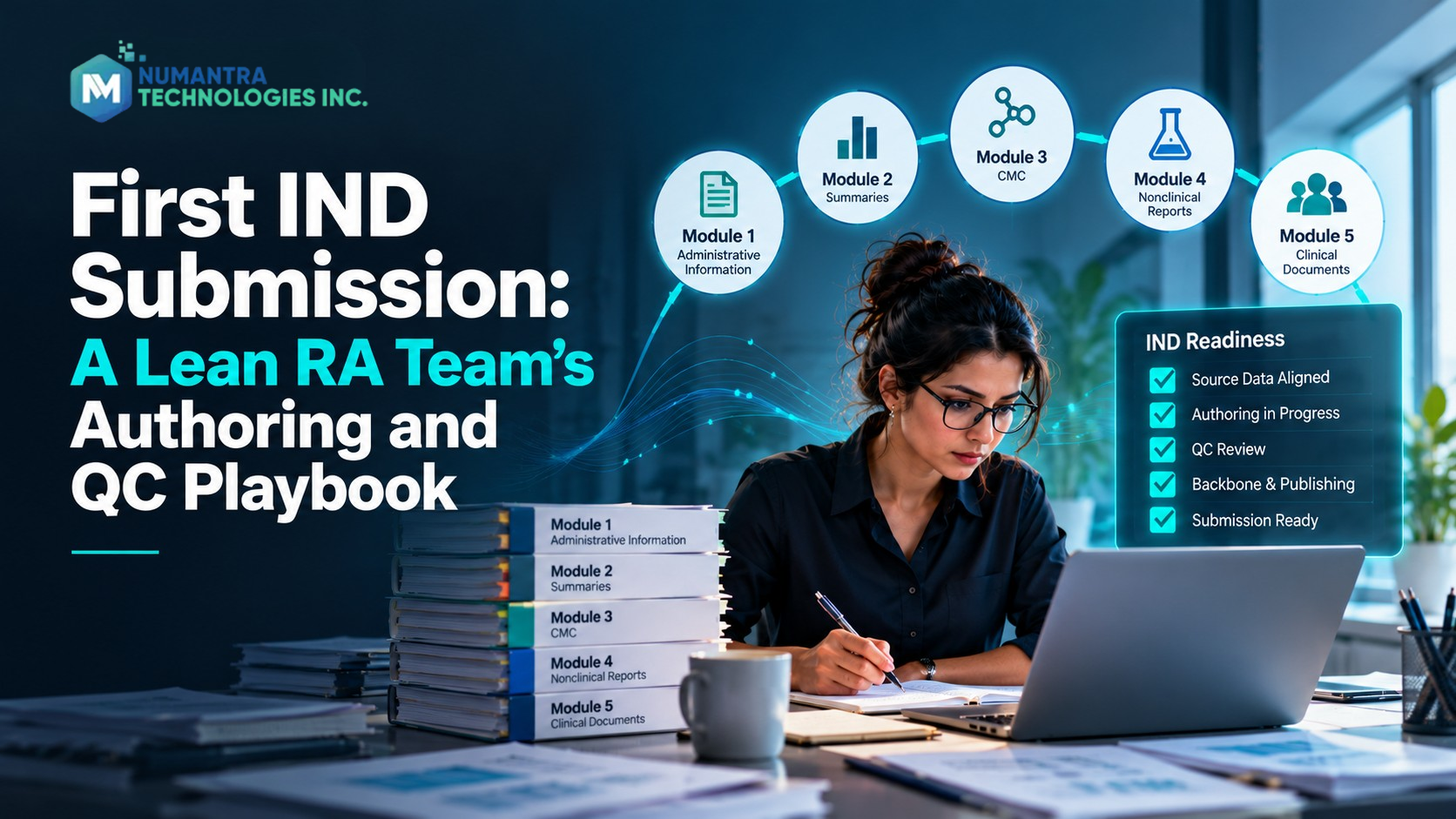
A first IND is rarely hard because of any single document. It is hard because one or two people own all of them. The same regulatory lead who interprets Pre-IND feedback is often also pulling stability tables out of a CDMO’s exports, checking whether the Module 3 drug substance narrative matches the batch records, restructuring clinical summaries, and troubleshooting the eCTD backbone the night before the gateway submission.
Larger sponsors spread this across authoring, QC, publishing, and RIM specialists. A five-person biotech RA team, or a team of one, absorbs every handoff and every rework loop personally. This playbook breaks a first IND into the phases where lean teams lose the most time, and shows where automation can take on mechanical work while human review stays in control.
Why First INDs Stress Small Teams Differently
The workload is not simply smaller because the company is smaller. A first IND still has to satisfy the same requirements under 21 CFR Part 312: an organized eCTD with the right CTD modules, internally consistent data, and a technically valid package. What changes is who is available to do the work.
Three pressures dominate:
- No dedicated QC reviewer. The author is also the checker, which is how transcription errors between source tables and narrative survive to submission.
- No publishing function. Backbone assembly, bookmarks, hyperlinks, and sequence metadata become an afterthought handled under deadline.
- Fixed timelines with moving inputs. Pre-IND feedback, late CDMO data, and nonclinical report finalization all arrive after the plan was set.
The approach below treats each of these as a workflow problem rather than a staffing problem.
Phase 1: Build the First IND Submission Checklist Around Source Data
Most checklists list documents. A more useful one lists data dependencies, because delays come from waiting on inputs, not from writing.
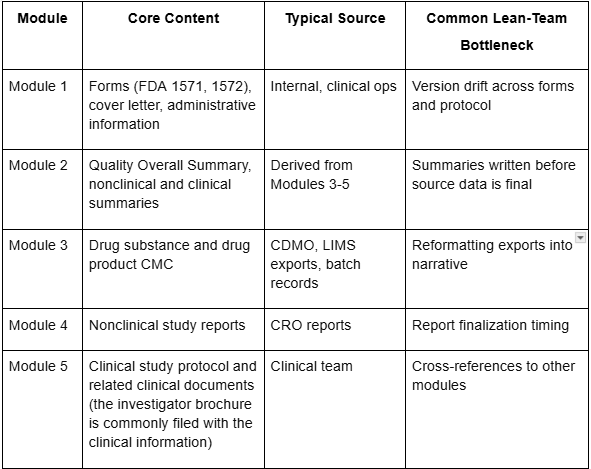
Checklist principle: assign every row an owner, a data-lock date, and a downstream dependency. Module 2 should never be drafted from data that Module 3 or 4 might still change. Sequence the work so summaries are finalized last, and keep a running record of which summary statements rest on which source tables.
Phase 2: Module 3 Authoring Without a CMC Writing Team
For a first IND, CMC content is typically thinner than at NDA stage, but it still has to be accurate, consistent, and traceable. The labor is mostly mechanical: taking tabular data from a LIMS export or CDMO report and turning it into the structured narrative sections that Module 3 expects, in line with ICH M4Q(R1).
Where the Hours Actually Go
- Locating the correct table in a merged or scanned source document
- Re-typing or re-formatting results into submission tables
- Writing the descriptive narrative around the data
- Checking that every number in the narrative matches the table
Steps 1, 2, and 4 are the strongest automation candidates. ARIA, NuMantra’s AI Regulatory Intelligence and Authoring platform, approaches this through its Author capability, which generates Module 3 narrative from source data such as LIMS exports, stability tables, and batch records, aligned to an approved language library and ICH M4Q(R1).
Two design points matter for a lean team:
- Layout-aware parsing. ARIA uses a proprietary layout-aware OCR engine that preserves tables, headers, and section structure from raw inputs like scanned PDFs, rather than flattening them into plain text. Table integrity is the difference between usable and unusable extraction.
- Traceability. Every generated claim links back to the exact paragraph, table, or figure it came from. For a one-person QC function, this turns checking from a hunt through source files into a click-through verification.
Human sign-off remains central. Every draft requires review before it is final. The value is that the reviewer starts from a traceable draft instead of a blank page.
Phase 3: Responding to Pre-IND Feedback Without Derailing the Plan
Pre-IND meeting feedback is where timelines most often slip for small teams, because feedback changes the content of documents that were already in progress.
A disciplined response workflow looks like this:
Step 1: Decompose the Feedback
Separate each comment into one of three buckets: (a) requires new data, (b) requires restructuring or re-presentation of existing data, (c) requires clarification only. Only bucket (a) threatens the timeline. Buckets (b) and (c) are authoring and formatting work, which is exactly what can be compressed.
Step 2: Map Each Comment to Affected Sections
Build a simple impact map: comment, affected CTD section, affected summary statements, owner, due date. Lean teams that skip this step discover downstream inconsistencies during final QC, when fixing them is most expensive.
Step 3: Track Changes at the Source, Not the Summary
Revise the underlying source table or narrative first, then regenerate or update the dependent summary text. Editing summaries directly while leaving sources untouched is how contradictions enter a dossier.
Phase 4: Module 2.7 Restructuring After Feedback
Module 2.7 (Clinical Summary) is a frequent casualty of Pre-IND feedback, particularly when the agency asks for different emphasis, clearer rationale, or reorganized presentation of the supporting information. For a first-in-human program the clinical content is limited, but the structure still has to hold together and agree with Module 5 and the protocol.
Restructuring checklist for Module 2.7:
- Confirm the section hierarchy matches the intended CTD organization
- Re-verify every cross-reference to Module 4 and Module 5 content
- Reconcile terminology and dose descriptions with the final protocol and investigator brochure
- Re-check that no statement in 2.7 outpaces the underlying data
The repetitive part of this work is moving content into the right sections and verifying that placements are correct. ARIA’s Classify capability assigns content from large merged files to the correct CTD sections, with visible reasoning and confidence scores for each assignment. A reviewer can scan the low-confidence assignments first and confirm or correct them, instead of reading every page. As with all ARIA outputs, classifications require human approval.
Phase 5: Validation and IND Publishing Under Deadline
Publishing problems are disproportionately painful for small teams because they surface last. A document that looks fine in isolation can still fail at the package level through broken hyperlinks, missing or malformed metadata, or XML backbone errors.
Pre-compile validation checklist:
Check | What It Catches
————————————————–
- XML backbone validation | Structural errors in the eCTD backbone
- Hyperlink validation | Broken or misdirected cross-document links
- Metadata validation | Missing or inconsistent leaf attributes and sequence information
- Section completeness | Empty or misplaced CTD nodes
ARIA’s Validate capability runs XML, hyperlink, and metadata validation before compile, and its Publish capability assembles the multi-regional eCTD backbone, packaged per authority (FDA, EMA, PMDA, Health Canada). For a first IND going to FDA, the practical value is catching mechanical defects while there is still time to fix them, rather than after a technical rejection.
Run validation early and repeatedly. Treat the final validation as a confirmation, not a discovery event.
Scenario: A Three-Person RA Team Preparing a First INDn
Consider a preclinical oncology biotech with a three-person regulatory team preparing its first IND. The Pre-IND meeting produced comments requesting clearer presentation of the CMC control strategy and a reorganized clinical summary.
Without automation, the team spends the weeks after the meeting re-extracting stability and release data from CDMO exports, rewriting Module 3 narrative by hand, manually re-sorting content into the summary structure, and discovering during final QC that two numbers in the Quality Overall Summary no longer match the updated tables. Publishing begins late, and validation errors are found within days of the target submission date.
With a structured workflow, the team decomposes the Pre-IND comments into data, restructuring, and clarification buckets on day one. Source tables are parsed with layout preserved, narrative drafts are generated with claim-level links to the original tables, and merged documents are classified into CTD sections with confidence scores the reviewer can triage. Validation runs at each milestone rather than once at the end. The people on the team still make every judgment call. They simply stop spending their hours on retyping, re-sorting, and re-checking.
Working Alongside Existing Systems
Small teams rarely have a blank slate. Documents live in SharePoint, a CDMO shares data through a LIMS, and a quality system such as TrackWise or an EDMS may already be in place. ARIA is designed to work alongside existing systems, with integrations including Veeva Vault, SharePoint, LIMS, EDMS, TrackWise, and Documentum, rather than requiring a replacement of them. Its Track capability also gives teams submission status and lifecycle tracking, and can serve as a phaseable path off legacy RIM systems as the company grows.
Data Handling Considerations for Sponsors
Before placing unpublished program data into any platform, regulatory leaders should ask where it lives and how it is used. ARIA is hosted on AWS with residency and disaster recovery built into the infrastructure. Tenant data is isolated and never pooled across customers, and customer data is never used to train underlying AI models. Role-based access control, audit logs, and encryption in transit and at rest are part of the design, and the platform is built around 21 CFR Part 11 and EU Annex 11 requirements.
A Practical Sequence for Your Team
- Week 1: Build the data-dependency checklist and assign owners and data-lock dates.
- Weeks 2-4: Parse source data and draft Module 3 narrative with traceable claim links; review against sources.
- After Pre-IND feedback: Decompose comments, map impact, update sources first, then regenerate dependent summaries.
- Module 2.7: Restructure, confirm cross-references, and reconcile with protocol and Module 5.
- Final stretch: Validate early and often; compile only when XML, hyperlink, and metadata checks are clean.
- Throughout: Keep a human reviewer on every draft, classification, and approval.
The Bottom Line
A lean team does not need to out-staff a large sponsor to file a clean first IND. It needs to remove the mechanical work, keep every statement traceable to its source, and catch defects early. Automation handles extraction, classification, and validation. Experienced regulatory judgment handles everything that matters.
Book a 15-minute ARIA demo to see how the platform supports a first IND with a lean team.