Introducing ARIA: AI for Regulatory Intelligence & Authoring, our new AI agent, built on everything you already know from NuMantra.
November 3, 2026
admin
KEEPING 3.2.P.8.3 STABILITY TABLES CURRENT ACROSS SITES AND CDMOS
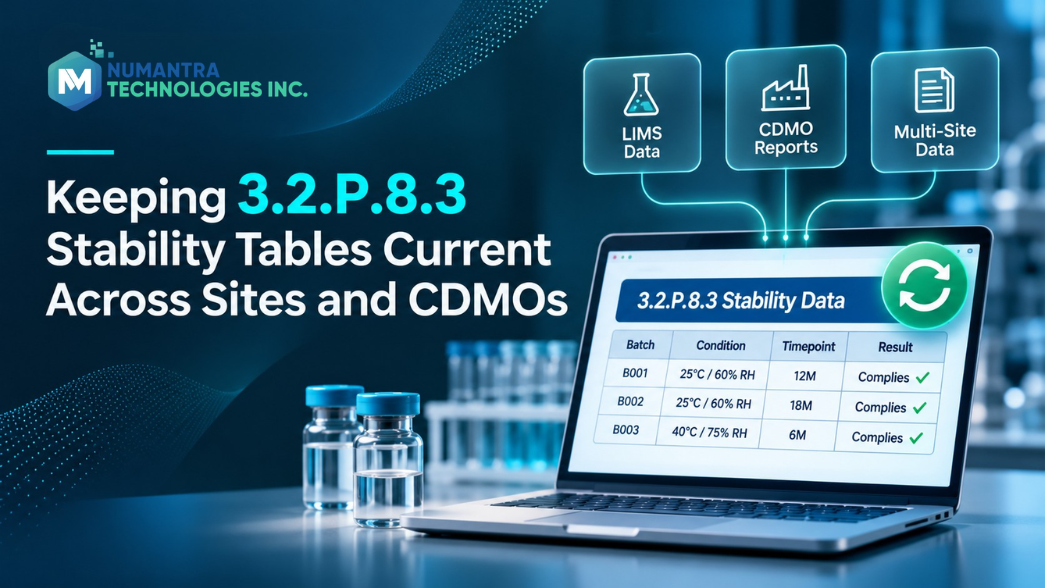
A stability table in Module 3 starts aging the moment it is finalized. A 12-month pull posts to the LIMS, an 18-month result follows, a second site starts generating data under a transferred method, and the 3.2.P.8.3 table you locked for the last sequence no longer matches the data the program is actually holding. For sponsors working with one or more CDMOs, the gap between what the LIMS says and what the submission says is where version-control errors, reviewer questions, and weeks of schedule slip tend to originate.
This article looks at one narrow problem: how stability data moves from LIMS exports and CDMO reports into the 3.2.P.8.3 table (Stability Data), why that path breaks down during tech transfer, and what a more controlled, traceable workflow looks like.
Why 3.2.P.8.3 Goes Stale
In the CTD structure defined by ICH M4Q(R1), section 3.2.P.8 (Stability) is organized into three parts: 3.2.P.8.1 (Stability Summary and Conclusion), 3.2.P.8.2 (Post-approval Stability Protocol and Stability Commitment), and 3.2.P.8.3 (Stability Data). The first two are largely narrative and change infrequently. The third is a data presentation section, and it changes whenever the underlying study changes.
Three forces keep the table in motion:
- New timepoints. Long-term, intermediate, and accelerated conditions each generate results on their own schedules.
- New batches and presentations. Additional primary, registration, or commitment batches add rows and columns.
- New sites and methods. Manufacturing or testing moves to a new facility, and the data set now spans more than one origin.
The result is a table that is accurate on the day it is built and increasingly out of step with the source systems afterward. The evaluation of stability data itself follows the principles in ICH Q1A(R2) and ICH Q1E, but the mechanical task of getting the right numbers into the right cells is an operations problem, not a science problem.
Three pressures dominate:
- No dedicated QC reviewer. The author is also the checker, which is how transcription errors between source tables and narrative survive to submission.
- No publishing function. Backbone assembly, bookmarks, hyperlinks, and sequence metadata become an afterthought handled under deadline.
- Fixed timelines with moving inputs. Pre-IND feedback, late CDMO data, and nonclinical report finalization all arrive after the plan was set.
The approach below treats each of these as a workflow problem rather than a staffing problem.
Where the Manual Workflow Breaks
Most teams assemble 3.2.P.8.3 the same way: export results from the LIMS, paste them into a working spreadsheet, reconcile against a CDMO stability report, reformat to the house template, and hand the output to a publishing team. Each handoff is a place for error.
 Re-extraction at every update
When a new timepoint posts, the whole chain restarts. Someone re-exports, someone re-checks the prior timepoints for silent changes, and someone rebuilds the formatted table. Because the table is a derivative of the export rather than a live view of it, nothing flags that a previously reported value was corrected upstream.
Divergent formats across sources
A sponsor LIMS, a CDMO LIMS, and a PDF stability summary rarely agree on units, rounding, batch naming, condition labels, or reporting-limit conventions. Reconciling them is manual interpretation work, and the interpretation is rarely documented.
Version drift between spreadsheet, report, and table
The most damaging failures are quiet ones: a table built from an export that is one refresh behind the CDMO report, or a batch identifier transcribed differently in the table than in the batch record. These tend to surface late, during internal QA review or, worse, as an agency information request.
Tech Transfer Multiplies the Problem
Tech transfer compresses all of the above into a short window. Data now originates at a sending site and a receiving site, often with differing analytical equipment, differing LIMS configurations, and different documentation conventions. The submission still needs one coherent story in Module 3.
A practical way to frame the risk is to separate what must stay constant from what changes during transfer:
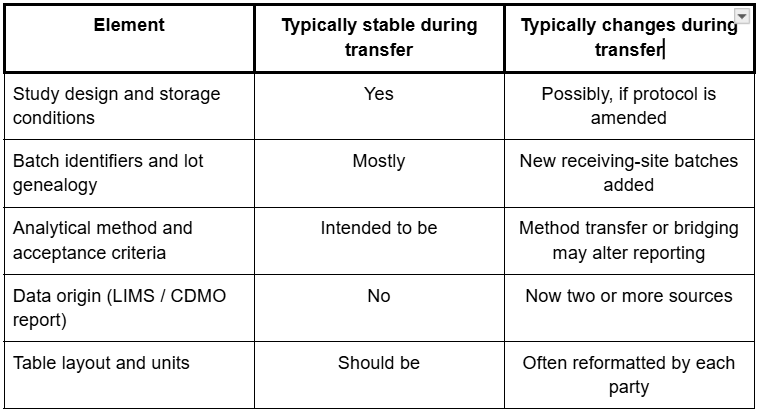
The right-hand column is where reconciliation effort concentrates. Each change needs to be traceable to a source record so that a reviewer, an inspector, or your own QA team can see why a value appears where it does.
A Reconciliation Checklist for CMC and RA Teams
Whether the process is manual or assisted, a controlled 3.2.P.8.3 update tends to cover the same ground. The following checklist is a working aid, not regulatory guidance:
- Source of truth declared. Which system is the authoritative record for each result: sponsor LIMS, CDMO LIMS, or a signed report?
- Batch map maintained. Every batch in the table maps to a batch record, a site, and a presentation.
- Condition and timepoint labels normalized. Long-term, intermediate, and accelerated conditions use one naming convention across sources.
- Units, rounding, and reporting limits aligned. Differences between sites are resolved and documented, not silently overwritten.
- Prior timepoints re-verified. Previously reported values are compared against the current export to catch upstream corrections.
- Out-of-trend and out-of-specification results traceable. Any flagged result links to its investigation record.
- Table-to-narrative consistency checked. The 3.2.P.8.1 conclusion and any shelf-life statement still reflect the data in 3.2.P.8.3.
- Lifecycle intent confirmed. The team knows whether the update will be a replacement or a new document in the next eCTD sequence.
The eCTD Lifecycle Side of a Stability Update
Getting the table right is only half of the job. The updated 3.2.P.8.3 document also has to land correctly in the eCTD backbone. Each stability update raises a lifecycle question: does the new file replace the prior leaf, or does it append alongside it? A wrong operation attribute can leave a stale table active in the current view of the application, or orphan a leaf the reviewer expected to see.
This matters more now. The FDA began supporting eCTD v4.0 forward compatibility on October 16, 2026, allowing v4.0 submissions for applications originally established in v3.2.2 while preserving existing lifecycle history. The agency has also stated it will begin rejecting submissions that fail specified high-severity eCTD v3.2.2 and v4.0 validations on January 16, 2027. Forward compatibility alone does not guarantee a valid submission. A stability update sequence with a broken hyperlink, a malformed backbone entry, or incorrect metadata is exactly the kind of avoidable technical rejection teams should plan around.
For programs that expect several stability updates across an IND, an NDA review, or post-approval commitments, the lifecycle behavior of 3.2.P.8.3 should be treated as a standing operating concern rather than something solved fresh each time.
How ARIA Approaches the Stability Data Path
ARIA, NuMantra’s AI Regulatory Intelligence and Authoring platform, is built around the idea that the path from source data to submission-ready Module 3 should be connected and traceable rather than a chain of manual handoffs.
For the 3.2.P.8.3 workflow, the relevant capabilities work together:
- Parsing raw source files. ARIA’s proprietary layout-aware OCR engine reads scanned PDFs, LIMS exports, and merged documents while preserving tables, headers, and section structure, so a CDMO stability report is treated as structured content instead of flat text.
- Authoring from source data. The Author capability generates Module 3 narratives from LIMS exports, stability tables, and batch records, aligned to an approved language library and ICH M4Q(R1).
- Traceable output. Every generated claim links back to the exact paragraph, table, or figure it came from. When a reviewer asks where a value originated, the answer is a click away instead of a spreadsheet hunt.
- Validation before compile. The Validate capability checks XML, hyperlinks, and metadata before the sequence is compiled, which addresses the class of defects that drive technical rejection.
- Multi-regional assembly and tracking. Publish assembles the eCTD backbone packaged per authority (FDA, EMA, PMDA, Health Canada), and Track follows submission status and lifecycle so the current state of each stability update is visible.
Underneath these sits the Knowledge Backbone for Regulatory Operations, which connects source data (LIMS, stability studies, batch records, CDMO reports), generated narratives, CTD submissions, and regulatory guidance into one queryable layer. The point is not to add another silo. It is to make the relationship between a LIMS result and the sentence or table cell that cites it explicit and searchable.
Human review remains central throughout. Every draft, classification, and approval requires human sign-off before it is final. ARIA augments the regulatory and CMC professionals responsible for the filing; it does not replace their judgment. It is also designed to work alongside existing systems, with integrations spanning Veeva Vault, SharePoint, LIMS, EDMS, TrackWise, and Documentum, rather than asking teams to abandon their current stack.
Scenario: A Mid-Size Biotech Mid-Transfer
Consider a hypothetical mid-size oncology biotech preparing an NDA for a drug product manufactured at a CDMO. Midway through the review of its registration batches, the program transfers fill-finish to a second CDMO site to add capacity. Stability studies on the original batches continue, new batches begin at the receiving site, and a 12-month long-term pull posts for the first set while 6-month data arrives for the second.
Under a manual process, the CMC lead requests exports from both CDMOs, the regulatory operations team rebuilds the table in a working file, and QA performs a line-by-line check against two PDF reports. Three weeks later, the table is ready, but a later QA pass finds that an 18-month value for one batch was corrected at the sending site after the export was taken. The table, the narrative in 3.2.P.8.1, and the prior sequence are now inconsistent, and the team restarts.
In a connected workflow, the source files from both sites are parsed with their structure intact, results are tied to batches and conditions, and the draft table and narrative reference the specific source tables they came from. When the upstream correction lands, the team can see which cells depend on the changed record. The reviewer still approves the final content, and the update is validated before it is compiled into the next sequence. The goal is not to eliminate review but to make it faster and better focused, because the evidence is already attached.
Practical Takeaways
- Treat 3.2.P.8.3 as a living data view, not a one-time deliverable, and plan for the update cadence your study schedule implies.
- Declare a source of truth for each result and document how multi-site discrepancies are resolved.
- Re-verify prior timepoints on every refresh to catch silent upstream corrections.
- Pair content updates with lifecycle planning so each stability update behaves correctly in the eCTD backbone.
- Build validation into the workflow before compile, particularly with the January 16, 2027 FDA validation rejection date approaching.
See the LIMS-to-3.2.P.8.3 Path in Action
If your team is spending weeks re-extracting and reformatting stability data every time a timepoint posts or a site changes, the bottleneck is likely in how data moves between systems, not in the science. Book a 15-minute ARIA demo to see how source files from LIMS and CDMO reports become traceable, validated Module 3 content, and where that path can shorten your stability update cycle.