Introducing ARIA: AI for Regulatory Intelligence & Authoring, our new AI agent, built on everything you already know from NuMantra.

November 11, 2026
admin
eCTD Vendor Scorecard: 12 Criteria to Evaluate Before You Sign
In This Article
———————————————
- Executive Summary
- Why Vendor Evaluations Stall
- How to Run the Scorecard
- The 12 Criteria
- Comparing Workflow Models
- Practices and Pitfalls
- Scenario: A Mid-Size Biotech Runs a Pilot
- A Practical 30/60/90-Day Starting Approach
- Conclusion and Next Step
- References & Sources
Executive Summary
The FDA began supporting eCTD v4.0 forward compatibility on October 16, 2026, and will begin rejecting submissions that fail specified high-severity eCTD v3.2.2 and v4.0 validations on January 16, 2027 [1]. For a VP of Regulatory Affairs, that makes the choice of publishing and authoring platform a deadline-driven decision rather than a routine renewal. Most evaluations still run on demos, reference calls, and a feature checklist that every vendor can satisfy on paper. This article offers a 12-criterion scorecard that moves the conversation from claims to evidence: validation depth, eCTD 4.0 readiness, Part 11 controls, authoring automation, integration fit, and total cost. You will leave with a weighting method, a set of questions to put to every vendor, and a pilot design that tests a platform against your own submission.
Why Vendor Evaluations Stall
Evaluations of eCTD software tend to fail in one of three ways. They drag on because no one agreed on criteria before the first demo. They default to the incumbent because switching cost is visible while the cost of staying is not. Or they get decided on the strength of the most polished presentation rather than the most defensible evidence.
The regulatory stakes make this expensive. A technical rejection is not a scientific finding, but it still delays the start of review and consumes the same team that is already stretched across the next filing. The FDA’s published validation criteria and eCTD technical specifications define what a submission has to satisfy to be accepted for processing [2][3]. Forward compatibility with v4.0 does not by itself guarantee a valid submission without rigorous rule verification [1].
The diagnostic question for any regulatory leader is this: if your current platform and your shortlisted platform each received the same submission tomorrow, could you show, with evidence, which one catches more defects before the gateway does? A scorecard exists to answer that question without relying on anyone’s marketing.
💡 NOTE: The operational risk. Teams often discover the weakness in a validation tool at the worst moment, during final compile, when a rule they assumed was covered is not. Scoring validation depth before purchase moves that discovery to a period when it costs nothing.
How to Run the Scorecard
Before scoring any vendor, do three things.
- Assign weights first. Distribute 100 points across the 12 criteria below based on your portfolio. A sponsor filing mostly US INDs weights FDA validation differently than a sponsor running parallel FDA, EMA, and PMDA submissions. Weighting after the demos invites bias.
- Define evidence, not assertion. For each criterion, decide in advance what counts as proof: a documented rule list, a live test on your file, a validation package, or a reference customer in your segment.
- Score on a 0 to 3 scale. Zero means not supported, 1 means supported with manual workarounds, 2 means supported and demonstrated, 3 means supported, demonstrated on your own data, and documented. Multiply by weight and total.
The 12 Criteria
🔹 Group A: Validation and Standards Readiness
- Validation rule coverage. Ask for the list of regional validation rules the tool checks and how it maps to the FDA and EMA published criteria [2][4]. A vendor that cannot show rule-level coverage is asking you to trust a number.
- Pre-compile versus post-compile checking. Defects caught before the package is assembled are cheaper than defects caught after. Ask where in the workflow each class of check runs, including XML, hyperlink, and metadata checks.
- eCTD v4.0 readiness. Establish what the platform does today for v3.2.2 and v4.0, how it handles a v3.2.2 application with lifecycle history that adds v4.0 content under forward compatibility, and what its roadmap commitments are [1][5]. Request a dated statement rather than a general assurance.
- Multi-regional packaging. If you file in more than one region, check whether one backbone can be packaged per authority (FDA, EMA, PMDA, Health Canada) or whether each region is a separate project.
🔹 Group B: Compliance and Security
- 21 CFR Part 11 controls. Part 11 sets criteria for electronic records and electronic signatures, including audit trails, access controls, and signature manifestations [6]. Ask how each is implemented and how the vendor supports your own validation effort. For EU operations, the corresponding expectations sit in EU GMP Annex 11 [7].
- Traceability and audit trail. Beyond Part 11 minimums, ask whether any generated content can be traced back to its source paragraph, table, or figure. Traceability shortens both internal review and inspection preparation.
- Data security and tenancy. Ask where data is hosted, whether tenant data is isolated or pooled, whether customer data is used to train models, and what access controls and encryption are in place. Written answers give you something to attach to the scorecard.
🔹 Group C: Authoring and Automation
- Authoring automation. Test how the platform moves from source data (LIMS exports, stability tables, batch records) to a draft Module 3 narrative aligned to ICH M4Q(R1) [8]. Ask whether a human reviews and approves each draft before it is final. A tool that skips human sign-off is a risk, not a feature.
- Document classification. Large merged files need to be sorted into the right CTD sections. Ask whether assignments are accompanied by visible reasoning and confidence levels, so reviewers can focus on the uncertain cases.
- Handling of raw inputs. Scanned PDFs and legacy documents are routine. Check how the platform parses them and whether table and header structure survives, or whether everything collapses into flat text.
🔹 Group D: Fit and Cost
- Integration with your existing stack. Confirm named integrations with the systems you already run, such as Veeva Vault, SharePoint, LIMS, EDMS, TrackWise, and Documentum, and ask which are production integrations versus custom projects. The right platform works alongside your systems rather than demanding their replacement.
- Total cost and exit path. Compare licensing, validation effort, migration, training, and the cost of running two systems during transition. Ask what a phased move off a legacy regulatory information management system looks like, and what data export you get if you leave.
💡 NOTE: The NuMantra perspective. Criteria 1, 3, and 5 are the ones most often reduced to a yes in a vendor questionnaire. We suggest asking for the evidence behind each yes: a rule list, a dated v4.0 statement, and a Part 11 control matrix. Vendors with substance tend to welcome the request.
Comparing Workflow Models
The scorecard also surfaces a structural difference between traditional and AI-native approaches.
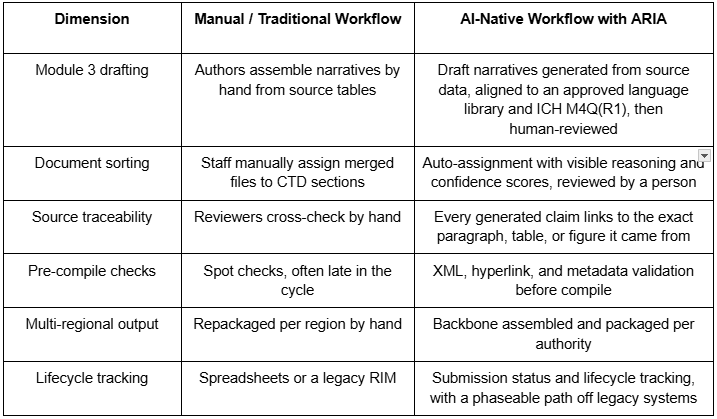
ARIA, NuMantra’s AI Regulatory Intelligence and Authoring platform, is built around five capabilities (Author, Classify, Validate, Publish, Track) on a Knowledge Backbone that connects source data, generated narratives, submissions, and guidance in one queryable layer. Score it against the same 12 criteria as every other vendor.
💡 NOTE: Where the time goes. In many evaluations, the hours are not lost to compiling the package. They are lost reconciling source data against narratives and chasing broken cross-references after the fact. Scoring criteria 2, 6, and 8 directly targets that effort.
Practices and Pitfalls
🔹 Practices That Hold Up
- Weight before you watch. Teams often agree weights in a single working session before any vendor presents, which reduces the pull of a strong demo.
- Test on your own submission. A pilot on a real file exposes validation and classification behavior that curated demo data hides.
- Include a Part 11 reviewer. Quality and IT stakeholders tend to raise the questions about audit trails and access control that regulatory affairs alone may miss.
- Ask for the exit plan. Vendors confident in their product are usually comfortable describing data export and transition terms.
🔹 Pitfalls to Avoid
- Scoring features instead of evidence. A yes in a questionnaire is not a demonstrated capability.
- Letting the incumbent set the baseline. Familiarity can be mistaken for fit, so score the current vendor on the same sheet.
- Ignoring validation effort. The effort to validate a system for your intended use is a real cost, and it belongs in criterion 12.
- Treating v4.0 as a future problem. With forward compatibility already supported and a rejection date set, readiness is a present-tense criterion [1].
Scenario: A Mid-Size Biotech Runs a Pilot
Consider a mid-size oncology biotech preparing an NDA with a large Module 3 and a stability package drawn from several CDMO reports. The regulatory operations director shortlists three platforms and assigns weights, giving the heaviest to validation coverage, traceability, and integration with the company’s existing document system.
Rather than rely on demos, the team picks one real submission component, a Module 3 drug product section with its stability tables, and gives the same inputs to each vendor. They score what happens at each step: how the raw files are parsed, how documents are classified, what the validation step flags, and how long reviewers need to confirm or correct the output. Because every draft requires human sign-off, they also record how easy it is for a reviewer to follow a statement back to its source.
The result is a scored sheet with evidence attached to each number. The decision no longer turns on who presented best. It turns on observed behavior against the team’s own weighted priorities, and the sheet can be shown to leadership and quality as the basis for the choice.
A Practical 30/60/90-Day Starting Approach
🔹 Days 1 to 30: Define
Many teams use this period to agree the 12 criteria and weights, name the evaluation committee (regulatory, quality, IT), and select the pilot content. They also document the current platform’s performance against the same sheet, which sets a fair baseline.
🔹 Days 31 to 60: Evidence
A common approach is to issue the written questions for criteria 1, 3, 5, and 7, review the responses against the sheet, and run the pilot on the chosen submission component. Results are scored by at least two reviewers independently to limit bias.
🔹 Days 61 to 90: Decide
Teams often finish by modeling total cost for criterion 12, including validation and transition effort, reconciling the scores, and presenting a recommendation with the evidence attached. If a move is chosen, many sponsors phase it, starting with new submissions while legacy content stays where it is.
Conclusion and Next Step
With the FDA’s forward compatibility already live and a firm validation rejection date set for January 16, 2027, a structured evaluation is more useful than a longer one [1]. The 12 criteria above convert a subjective vendor comparison into a weighted, evidence-based decision that you can defend to leadership, quality, and inspectors.
The fastest way to apply the scorecard is to test it. Book a 15-minute ARIA live demo and bring your own scorecard. We will walk through ARIA against your highest-weighted criteria, from pre-compile validation to source-linked Module 3 drafting, so you can score it on the same sheet as everyone else on your shortlist. You can also ask about a pilot evaluation on one of your own submissions.
References & Sources
- U.S. Food and Drug Administration. “Electronic Common Technical Document (eCTD).” FDA, accessed 2026. https://www.fda.gov/drugs/electronic-regulatory-submission-and-review/electronic-common-technical-document-ectd
- U.S. Food and Drug Administration. “eCTD Technical Conformance Guide and Validation Criteria.” FDA, accessed 2026. https://www.fda.gov/drugs/electronic-regulatory-submission-and-review/electronic-common-technical-document-ectd
- U.S. Food and Drug Administration. “Providing Regulatory Submissions in Electronic Format: Submissions Under Section 745A(a) of the Federal Food, Drug, and Cosmetic Act.” FDA Guidance for Industry, accessed 2026. https://www.fda.gov/regulatory-information/search-fda-guidance-documents
- European Medicines Agency. “eSubmission: eCTD Validation Criteria and Technical Guidance.” EMA, accessed 2026. https://esubmission.ema.europa.eu
- International Council for Harmonisation. “M8: Electronic Common Technical Document (eCTD) v4.0 Implementation Package.” ICH, accessed 2026. https://www.ich.org/page/ectd
- U.S. Government Publishing Office. “21 CFR Part 11: Electronic Records; Electronic Signatures.” Code of Federal Regulations, accessed 2026. https://www.ecfr.gov/current/title-21/chapter-I/subchapter-A/part-11
- European Commission. “EudraLex Volume 4, Annex 11: Computerised Systems.” European Commission, accessed 2026. https://health.ec.europa.eu/medicinal-products/eudralex/eudralex-volume-4_en
- International Council for Harmonisation. “M4Q(R1): The Common Technical Document for the Registration of Pharmaceuticals for Human Use, Quality.” ICH, accessed 2026. https://www.ich.org/page/ctd