Introducing ARIA: AI for Regulatory Intelligence & Authoring, our new AI agent, built on everything you already know from NuMantra.

November 11, 2026
admin
Module 3 CMC Data Reconciliation: Gap Audit Checklist
In This Article
———————————————
- Executive Summary
- Why Module 3 Mismatches Surface Late
- The Reconciliation Map: Where Data Lives and Where It Must Agree
- A Scored Gap Audit Checklist for 3.2.P.5 and 3.2.P.8
- Where Manual Cross-Checking Breaks Down
- How AI-Native Reconciliation Changes the Workflow
- Practices and Pitfalls
- Scenario: A CDMO-Partnered Biotech Ahead of an IND Amendment
- A Practical 30/60/90-Day Starting Approach
- Conclusion and Next Step
- References & Sources
Executive Summary
Chemistry, manufacturing, and controls (CMC) content in Module 3 is assembled from many sources: CDMO batch records, laboratory information management system (LIMS) exports, stability reports, specification documents, and narrative text written by several authors. When these sources disagree, the disagreement usually surfaces during final assembly or, worse, during agency review. Quality and CMC deficiencies are a recurring subject of agency information requests and complete response letters, and FDA’s pharmaceutical quality program exists in part to address them [1]. The practical lesson is that reconciliation is not a pre-submission formality. It is the control that determines whether a Module 3 narrative can be defended line by line. This article provides a scored gap audit you can run on 3.2.P.5 (control of drug product) and 3.2.P.8 (stability), explains where manual cross-checking fails, and outlines a 90-day approach for getting reconciliation under control.
Why Module 3 Mismatches Surface Late
The Common Technical Document places quality information in Module 3, organized under ICH M4Q(R1) [2]. The structure is clean. The data feeding it is not. A typical drug product section draws on at least four independent origins:
- Batch records and certificates of analysis generated by the CDMO or internal manufacturing site.
- Release and shelf-life specifications maintained in controlled documents, often revised through change control on a different cadence than the data.
- Stability tables compiled from LIMS exports or CDMO stability reports, frequently reformatted by hand.
- Module 3 narrative text written by CMC authors who may be working from a prior version of any of the above.
Each source has its own owner, its own revision history, and its own definition of a “current” value. Mismatches are therefore a structural outcome, not an individual failure. A specification limit revised in the controlled document may not reach the stability table header. A batch number may be transcribed differently in the narrative than in the certificate of analysis. A pull point that was added to the protocol may be absent from the summary table.
The diagnostic question for a CMC leader is simple: if a reviewer picked any number in 3.2.P.5 or 3.2.P.8 at random, could your team trace it to a source record in minutes, and confirm that every other place that number appears says the same thing? If the honest answer is “not reliably,” the audit below is a good place to start.
💡 NOTE: The operational risk. Late-surfacing mismatches rarely stay small. A single inconsistency between a specification table and a stability table can prompt a broader reviewer question about data integrity and control strategy, which can then widen an information request well beyond the original discrepancy.
The Reconciliation Map: Where Data Lives and Where It Must Agree
Before scoring anything, define which Module 3 sections need to agree with which sources. The ICH guidelines that govern the content give you the checkpoints:
- ICH Q6A and Q6B describe how specifications are set and justified for chemical substances and biotechnological products [3][4].
- ICH Q1A(R2) describes the stability data package expected to support a proposed shelf life [5].
- ICH Q1E describes evaluation of stability data and the statistical basis for retest periods or shelf lives [6].
- ICH M4Q(R1) describes where each element sits within the CTD quality module [2].
🔹 The core agreement points
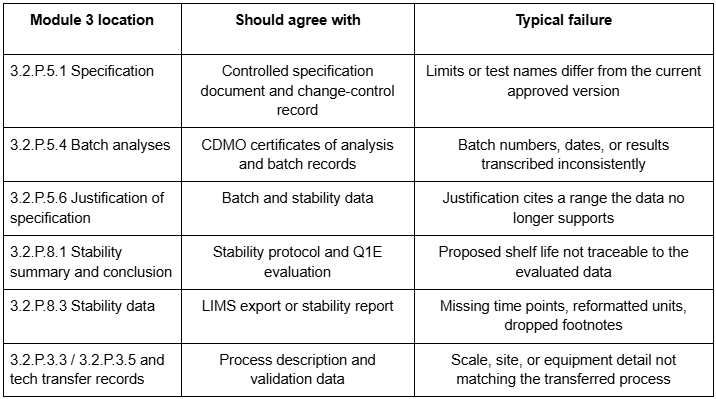
This table is the skeleton of the audit. Every row is a reconciliation relationship, and every relationship is a place where two documents owned by different people need to say the same thing.
A Scored Gap Audit Checklist for 3.2.P.5 and 3.2.P.8
The checklist below is designed to be run in a single working session and scored. Award 2 points for fully confirmed, 1 point for partially confirmed or confirmed only by memory, and 0 points for not checked or known mismatch. Maximum score is 40.
🔹 Part A: Specifications and batch analyses (3.2.P.5)
- Every test name and acceptance criterion in 3.2.P.5.1 matches the current approved specification version.
- The specification version cited in the narrative is the version in effect at the time of authoring.
- Analytical procedure references in 3.2.P.5.2 match those used to generate the batch data.
- Every batch listed in 3.2.P.5.4 can be traced to a certificate of analysis.
- Batch numbers, manufacture dates, and sites are identical across the narrative, tables, and source records.
- Reported results meet the stated acceptance criteria, with units and significant figures consistent.
- The justification in 3.2.P.5.6 is supported by the data actually presented, not by a prior data set.
- Any specification changes since the last submission are reflected in all dependent sections.
- Reference standard information is consistent between specification, methods, and narrative.
- Impurity limits and any qualification rationale are consistent wherever they appear.
🔹 Part B: Stability (3.2.P.8)
- The stability protocol, storage conditions, and pull points in the narrative match the executed protocol.
- Every time point in the summary appears in the data tables, and no time point is silently dropped.
- Stability-indicating attributes tested match the specification attributes.
- Container closure and presentation for each stability batch match the proposed commercial or clinical presentation.
- Batches placed on stability are identified consistently with the batch analyses section.
- Units, decimal precision, and footnotes survive transfer from source report to Module 3 table.
- The proposed shelf life or retest period is traceable to the evaluation described in the narrative, consistent with ICH Q1E principles [6].
- Out-of-trend or out-of-specification results are disclosed and explained consistently across sections.
- Post-approval or ongoing stability commitments match the protocol on file.
- Cross-references and hyperlinks to stability reports resolve to the correct document and page.
🔹 Reading your score
- 34 to 40: Reconciliation looks controlled. The focus shifts to keeping it that way through change control.
- 24 to 33: Gaps exist and are likely discoverable by a reviewer. Items scored 0 are the natural first priority.
- Below 24: Reconciliation is best treated as a critical-path activity, with dedicated time set aside before any filing milestone.
💡 NOTE: Where the time goes. In many CMC teams, the checking itself is the cheap part. The expensive part is finding the right source record, confirming it is the current version, and re-verifying after every upstream revision. Each late change restarts the cycle.
Where Manual Cross-Checking Breaks Down
Manual reconciliation fails for predictable reasons.
Volume without structure. A stability section can span dozens of tables across multiple batches and conditions. Reading them side by side against a specification document is slow, and attention degrades.
Version drift. The reviewer checks the narrative against the specification they have open, which may not be the latest. Nothing in the process forces confirmation of version.
Format loss at transfer. Scanned PDFs, LIMS exports, and merged documents lose table structure when copied. Footnotes detach from the values they qualify. Units get reformatted. Errors enter at the point of transcription, not analysis.
One-way checking. People check that the narrative matches the source, but rarely that the source set is complete. A missing time point or an omitted batch is invisible to a read-through.
No audit trail of the check itself. Electronic records and their review are expected to be attributable and traceable under 21 CFR Part 11 [7]. A reconciliation performed in a personal spreadsheet leaves little evidence of what was compared against what.
How AI-Native Reconciliation Changes the Workflow
ARIA, NuMantra’s AI Regulatory Intelligence and Authoring platform, addresses these failure modes by treating Module 3 as a connected body of evidence rather than a pile of documents. It is designed to work alongside existing systems such as Veeva Vault, SharePoint, LIMS, EDMS, TrackWise, and Documentum, not to replace them.
🔹 Step 1: Parse sources without losing structure
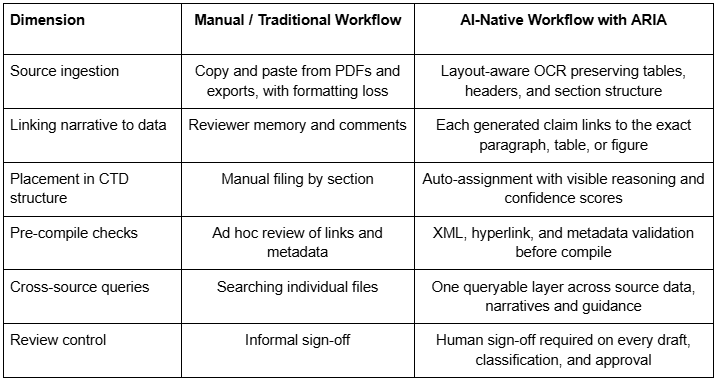
ARIA’s proprietary layout-aware OCR engine parses raw files, including scanned PDFs, LIMS exports, and merged documents, preserving tables, headers, and section structure rather than flattening everything to text. This matters for stability tables, where a footnote or unit in the wrong place changes the meaning of a value.
🔹 Step 2: Connect source data, narrative, and guidance
The Knowledge Backbone for Regulatory Operations links source data (LIMS, stability studies, batch records, CDMO reports), generated narratives, CTD submissions, and regulatory guidance into one queryable layer. It combines a Postgres relational foundation with vector search, so structured questions (which batches are in this table) and open-ended questions (where else is this limit described) can both be asked of the same body of content.
🔹 Step 3: Author with traceable claims
The Author capability generates Module 3 narrative from source data, aligned to an approved language library and ICH M4Q(R1). Every generated claim links back to the exact paragraph, table, or figure it came from, so a reviewer on your team can verify a statement against its origin in one step.
🔹 Step 4: Classify, validate, and publish
Classify assigns large merged files to the correct CTD sections with visible reasoning and confidence scores. Validate checks XML, hyperlinks, and metadata before compile. Publish assembles multi-regional eCTD backbones packaged per authority. Track supports submission status and lifecycle tracking. Throughout, human review remains central: every draft, classification, and approval requires human sign-off before it is final.
🔹 Comparison: manual versus AI-native reconciliation
💡 NOTE: The NuMantra perspective. Tooling should shorten the path to evidence, not replace the judgment of the CMC lead. The value is that a person can spend their time deciding whether a discrepancy matters instead of hunting for it.
Practices and Pitfalls
🔹 Practices That Hold Up
- Reconcile against a named version. Teams often record the specification and protocol version used for each check, so a later revision clearly invalidates only the affected rows.
- Check completeness, not just accuracy. A common approach is to verify that every planned time point and every executed batch appears in the output, in addition to checking values.
- Re-run reconciliation after each upstream change. Many sponsors choose to repeat the audit after specification revisions and CDMO report updates, rather than once before filing.
- Make the check itself reviewable. Capturing who compared what, and against which source, gives quality and regulatory a record to rely on if a question arises.
🔹 Pitfalls to Avoid
- Treating the narrative as the source of truth. Narrative text is derived content. Teams that reconcile the narrative only against itself miss upstream drift.
- Leaving tech transfer records out of scope. Process and site details in 3.2.P.3 often change at transfer and are easy to overlook when the audit focuses only on 3.2.P.5 and 3.2.P.8.
- Reformatting stability tables by hand late in the process. Late manual edits are a frequent entry point for dropped footnotes and unit errors.
- Relying on a single reviewer. One person reading dozens of tables creates a single point of failure that a structured checklist and traceable source links can reduce.
Scenario: A CDMO-Partnered Biotech Ahead of an IND Amendment
This illustrative scenario is a composite, not a specific customer. Consider a mid-size biotech preparing a Module 3 update to support a manufacturing site change. The drug product is made at a CDMO, release testing is split between the CDMO and an external lab, and the stability program has produced several rounds of reports.
The regulatory CMC director runs the 20-point audit and scores 22. The gaps are instructive:
- The narrative cites a specification version one revision behind the controlled document, and two impurity limits differ.
- One stability batch appears in the batch analyses section under a different identifier format than in the stability tables.
- A later time point for one storage condition is in the CDMO report but absent from the summary table.
- Two hyperlinks to stability reports point to a superseded file.
None of these is exotic. Each is the kind of inconsistency a reviewer can find in minutes and a team can miss in weeks. With a connected source layer, the team can trace each Module 3 value to its origin, confirm which version is current, and correct the narrative and tables in one pass, with the CMC lead signing off on each change. The remaining effort goes to the judgment calls: whether the impurity limit difference reflects an approved change or an error, and whether the missing time point changes the shelf life conclusion under Q1E principles [6].
A Practical 30/60/90-Day Starting Approach
🔹 Days 1 to 30: Baseline and map
Teams often begin by running the 20-point checklist on the current or next submission and recording the score by section. A common first step is building the reconciliation map for your product: which sources feed which Module 3 sections, who owns each, and how revisions are communicated. Many sponsors also agree with their CDMO on a standard data handoff format at this stage.
🔹 Days 31 to 60: Close priority gaps and add controls
A typical focus is items scored zero, starting with specification alignment and batch traceability. A frequent practice is linking the audit to change control, so that a specification or protocol revision triggers re-verification of the dependent Module 3 rows. This is also a reasonable point to evaluate tooling that preserves table structure and source links.
🔹 Days 61 to 90: Operationalize
Re-score the audit, compare against the baseline, and set a cadence, for example after each CDMO report and before each filing milestone. Many teams add reconciliation status to tech transfer milestone reviews so that data agreement is tracked alongside process readiness.
Conclusion and Next Step
Module 3 problems rarely begin as regulatory problems. They begin as small disagreements between a batch record, a specification, a stability table, and a paragraph of narrative. Because those documents have different owners and revision cycles, the disagreements are structural, and a scored, repeatable audit is the most direct way to find them before a reviewer does. Run the 20-point checklist on your current program, note where your score is weakest, and decide whether your tools make the evidence easy or hard to trace.
If you would like to see how this works on your own material, book a 15-minute ARIA live demo to see traceable Module 3 authoring, classification, and validation in action.
References & Sources
- U.S. Food and Drug Administration. “Pharmaceutical Quality Resources.” FDA Center for Drug Evaluation and Research. https://www.fda.gov/drugs/pharmaceutical-quality-resources
- International Council for Harmonisation. “M4Q(R1): The Common Technical Document for the Registration of Pharmaceuticals for Human Use: Quality.” ICH Harmonised Guideline. https://www.ich.org/page/ctd
- International Council for Harmonisation. “Q6A: Specifications: Test Procedures and Acceptance Criteria for New Drug Substances and New Drug Products: Chemical Substances.” ICH Harmonised Tripartite Guideline, October 1999. https://www.ich.org/page/quality-guidelines
- International Council for Harmonisation. “Q6B: Specifications: Test Procedures and Acceptance Criteria for Biotechnological/Biological Products.” ICH Harmonised Tripartite Guideline, March 1999. https://www.ich.org/page/quality-guidelines
- International Council for Harmonisation. “Q1A(R2): Stability Testing of New Drug Substances and Products.” ICH Harmonised Tripartite Guideline, February 2003. https://www.ich.org/page/quality-guidelines
- International Council for Harmonisation. “Q1E: Evaluation of Stability Data.” ICH Harmonised Tripartite Guideline, February 2003. https://www.ich.org/page/quality-guidelines
- U.S. Food and Drug Administration. “21 CFR Part 11: Electronic Records; Electronic Signatures.” Code of Federal Regulations, Title 21. https://www.ecfr.gov/current/title-21/chapter-I/subchapter-A/part-11