Introducing ARIA: AI for Regulatory Intelligence & Authoring, our new AI agent, built on everything you already know from NuMantra.
October 19, 2026
Creative buffer
Your Tech Transfer Isn’t Late. Your Module 3 Data Reconciliation Is
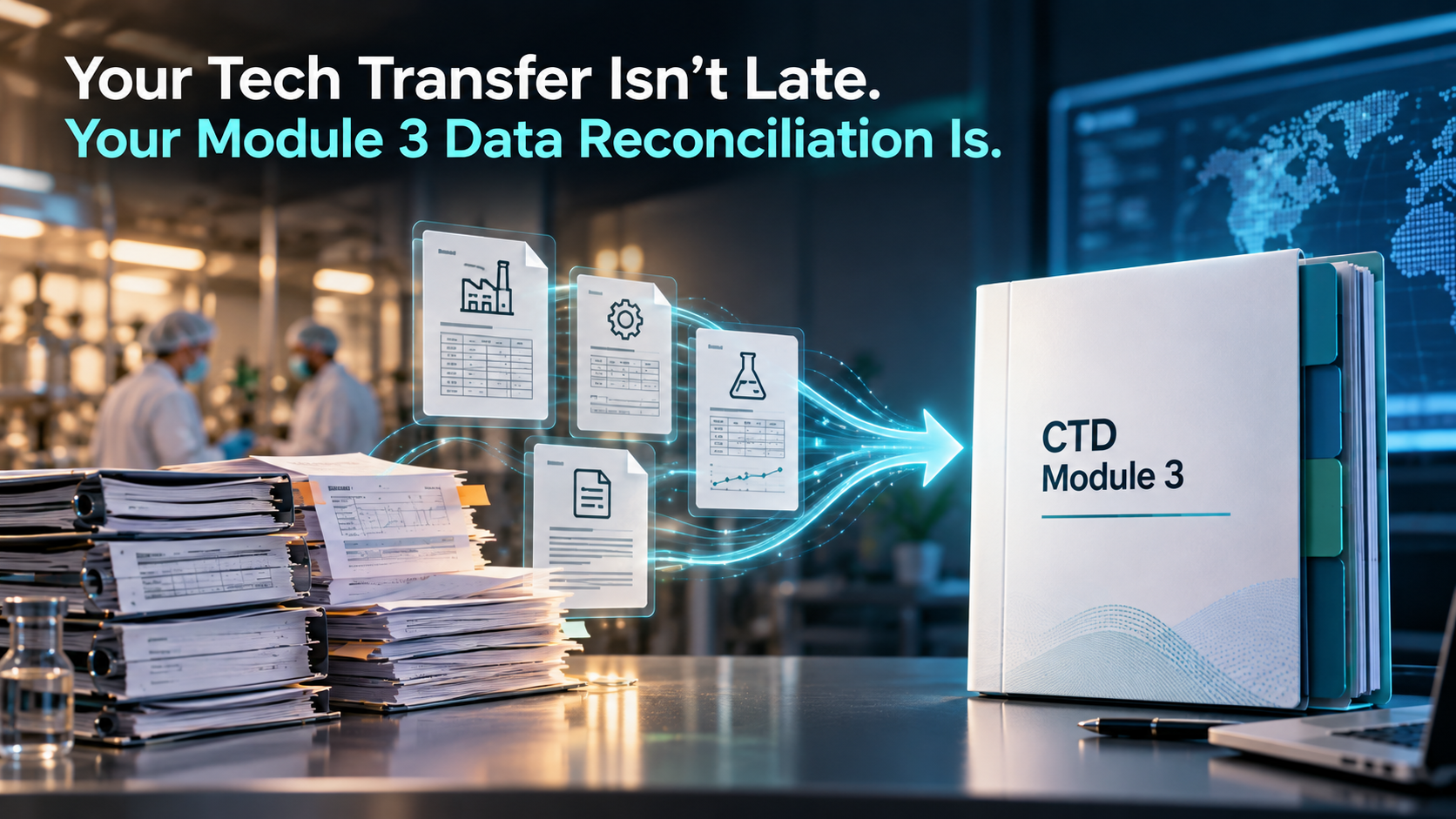
The batches passed. The process performance qualification (PPQ) campaign met its acceptance criteria. The CDMO’s quality unit signed the reports. And the dossier still cannot be filed.
If you run CMC or technical operations at a CDMO-dependent biotech, you have lived this. The tech transfer timeline on the Gantt chart ends at batch release. The real timeline ends when every number in Module 3 agrees with every number in the CDMO’s source documents. That second timeline is rarely planned, rarely staffed, and routinely the reason a filing date slips by weeks.
This article breaks down where CDMO-to-Module 3 handoffs fail, why the failure concentrates in 3.2.P.8 and the process validation sections, and what a source-linked, human-reviewed workflow looks like in practice.
Why the Handoff Breaks: Format Mismatch, Not Data Quality
The underlying science at the CDMO is usually sound. The problem is structural. A CDMO produces documents for its own quality system and for the sponsor’s technical review. Module 3 of the CTD, organized under ICH M4Q(R1), is built for a regulatory reviewer. The two are not designed to map onto each other.
What the CDMO delivers | What Module 3 needs
- Executed batch records (scanned PDF or eBR export) | Batch formula and batch analyses in 3.2.P.3.2 and 3.2.S.2.2
- Process validation / PPQ summary report | Process validation and evaluation in 3.2.P.3.5
- Stability data as LIMS export or lab-formatted tables | Stability summary, conclusion, and data tables in 3.2.P.8.1 to 3.2.P.8.3
- Deviation and investigation reports | Context for justification of specifications and control strategy
- Certificates of analysis per lot | Batch analysis data in 3.2.P.5.4
Where the Weeks Actually Go
The lost time tends to cluster in four places.
1. Retyping stability tables
Stability data from a CDMO or its contract testing lab typically arrives as spreadsheets or LIMS exports organized by study, not by the Module 3 presentation. Regulatory writers rebuild these into 3.2.P.8.3 tables organized by lot, storage condition, and time point, consistent with the expectations of ICH Q1A(R2) and the evaluation approach in ICH Q1E. Retyping is slow, but the real cost is the verification pass afterward, where a second person checks each cell against source.
2. Process validation summaries that drift from the report
The PPQ report is the controlled source. The Module 3 summary is a derived document. By the time the summary is written, the CDMO may have issued a report revision, a deviation may have been closed with a new root cause statement, or a reprocessing event may have changed the batch genealogy. The summary and the report quietly diverge.
3. The 3.2.P.8 narrative versus the data tables
The stability narrative in 3.2.P.8.1 states conclusions: proposed shelf life, storage conditions, any observed trends. The data tables in 3.2.P.8.3 hold the evidence. When one is updated after a new time point arrives and the other is not, a reviewer finds the discrepancy before you do. A narrative that says “no significant change through 18 months” next to a table showing an out-of-trend assay at 12 months is the kind of inconsistency that generates an information request.
4. Version and lot traceability across handoffs
A single lot may appear in the batch record, the CoA, the PPQ report, the stability protocol, and the stability report, sometimes with slightly different designations. Reconciling lot identity across five documents from two organizations is painstaking work, and it is almost never scheduled.
A Reconciliation Checklist You Can Use Today
Whether or not you adopt any tooling, these checks catch the most common handoff errors before they reach a reviewer.
How ARIA Automates the 40-Hour Module 3 CMC Validation in 15 Minutes
ARIA’s Author hub ingests raw source data (LIMS exports, stability tables, batch records) and auto-generates Module 3 narratives aligned to ICH M4Q(R1) structure. Every generated claim links back to the exact source paragraph, table, or figure.
- Every lot number in 3.2.P.8.3 appears identically in 3.2.P.5.4 batch analyses and the PPQ report
- Storage condition labels and time points match the stability protocol exactly
- Units and reporting precision are consistent between the CDMO report and the Module 3 table
- The shelf-life conclusion in 3.2.P.8.1 matches the statistical evaluation of the underlying data
- Specification limits quoted in stability tables match the current 3.2.P.5.1 specification
- Any CDMO report revision issued after drafting is reflected in the Module 3 text
- Cross-references and hyperlinks between narrative sections and data tables resolve to the correct targets
This list is a starting point for internal quality review, not a statement of what any authority requires of your specific application.
Why the Fix Is Traceability, Not Speed
It is tempting to frame this problem as a typing-speed problem and look for a faster way to produce tables. That framing misses the point. The expensive part is not producing the table. It is proving to yourself, and later to a reviewer, that the table is faithful to the source.
A workflow that addresses the real bottleneck has three properties:
- It parses source documents as structured content. A scanned CDMO stability report is not flat text. It has tables, headers, footnotes, and section structure that carry meaning.
- It links every generated statement back to its origin. If a sentence in the narrative cites a result, you can trace it to the exact table cell or paragraph it came from.
- It keeps a human reviewer in control. Regulatory and CMC experts approve every draft. Automation prepares and traces; people decide.
How ARIA Approaches the CDMO-to-Module 3 Handoff
ARIA, NuMantra’s AI Regulatory Intelligence and Authoring platform, was built around this traceability problem. Several of its capabilities map directly onto the handoff failure points above.
1. Parsing CDMO source files without losing structure
ARIA uses a proprietary layout-aware OCR engine that parses raw files, including scanned PDFs, LIMS exports, and merged documents, while preserving tables, headers, and section structure rather than flattening everything to text. For a CDMO stability report, that means a time-point table stays a table and can be mapped to the Module 3 presentation instead of being retyped.
2. Classifying large merged files into CTD sections
CDMOs frequently deliver a single large merged PDF containing batch records, reports, and appendices. ARIA’s Classify capability auto-assigns content to the correct CTD sections and shows its reasoning and a confidence score for each assignment, so your reviewer can accept or correct each placement.
3. Authoring Module 3 narratives from source data
ARIA’s Author capability generates Module 3 narrative from source data such as LIMS exports, stability tables, and batch records, aligned to an approved language library and ICH M4Q(R1). Because the narrative is generated from the same parsed data as the tables, the 3.2.P.8 text and its supporting tables start from one source rather than two hand-maintained copies.
4. Source-linked claims
Every generated claim links back to the exact paragraph, table, or figure it came from. When a reviewer asks where a stability conclusion originated, you can follow the link to the source instead of reconstructing the answer from emails with the CDMO.
5. Validation before compile
Before the package is assembled, ARIA’s Validate capability runs XML, hyperlink, and metadata checks, so broken cross-references between narrative sections and data tables surface during drafting rather than at gateway review. The Publish capability then assembles the eCTD backbone packaged for the target authority, whether FDA, EMA, PMDA, or Health Canada.
ARIA is designed to work alongside the systems you already use, including Veeva Vault, SharePoint, LIMS, EDMS, TrackWise, and Documentum. It does not ask you to replace your document management or quality systems to fix the handoff.
6. Human review stays central
Every draft, classification, and approval in ARIA requires human sign-off before it is final. The platform augments CMC and regulatory professionals. It does not replace their judgment, and it is built around 21 CFR Part 11 and EU Annex 11 design expectations, with audit logs, role-based access control, and encryption in transit and at rest.
Scenario: A Mid-Size Oncology Biotech Preparing an NDA Module 3
Consider a hypothetical mid-size oncology biotech that outsources both drug substance and drug product manufacturing to two different CDMOs. Three PPQ lots have been released. Stability studies at long-term and accelerated conditions are running at the CDMO’s testing lab, with an 18-month time point newly available.
The legacy workflow. The CMC lead receives a merged PDF from each CDMO plus a LIMS spreadsheet export. A regulatory writer manually sorts the PDF into CTD sections, rebuilds the stability tables for 3.2.P.8.3, drafts the 3.2.P.8.1 summary, and summarizes the PPQ report for 3.2.P.3.5. A second reviewer then verifies each table against source. When the CDMO issues a revised PPQ report after a deviation closure, the writer re-checks the summary by hand and hopes nothing else moved.
The source-linked workflow. The merged PDFs and LIMS export are ingested and parsed with structure preserved. Content is classified into 3.2.S and 3.2.P sections with visible confidence scores, and the CMC lead confirms or corrects assignments. Stability narrative and tables are drafted from the same parsed data, each statement linked to its source. When the revised PPQ report arrives, the source links show which Module 3 statements draw on that report, so the team knows where to look first. Hyperlink and metadata validation runs before compile.
The batches were never the problem in either version. The difference is where the team spends its time: reconstructing and re-verifying, or reviewing and deciding.
What to Ask Before Your Next Tech Transfer
Some practical questions to put to your own process:
- At what point in the tech transfer plan is Module 3 data format agreed with the CDMO?
- Who owns reconciling the CDMO report against the Module 3 text, and how is that tracked?
- When a CDMO report is revised, how do you identify every Module 3 statement it affects?
- Can any number in your 3.2.P.8 narrative be traced to its source in under a minute?
If the honest answer to the last question is “no,” the weeks are going to reconciliation, and that is where improvement is available.
See the Handoff Workflow in Action
If your filing timeline is being set by data reconciliation rather than by manufacturing, it is worth seeing what a source-linked Module 3 workflow looks like with your own document types in mind. Book a 15-minute ARIA demo to watch CDMO stability tables and PPQ content move from raw source files to classified, traceable Module 3 drafts, with your team reviewing every step.